Description
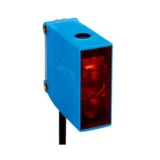
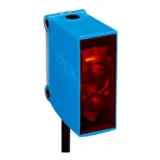
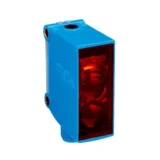
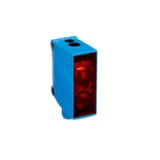
SICK GL10-P1211 Adjustable PNP Retro-reflective Sensor
Technical Overview
The SICK GL10-P1211 is a polarized dual-lens photoelectric retro-reflective sensor with a PNP output and selectable light/dark switching. With PL80A, sensing spans 0.15–12 m and maximum range is 0.08–15 m; P250 provides 0.15–10 m sensing and 0.08–12 m maximum range. Its 625 nm red PinPoint LED produces a 58 mm spot at 5 m. A 270° potentiometer adjusts sensitivity and a separate selector chooses output behavior. Response is no more than 500 µs with resistive load, with 1,000 Hz switching at a 1:1 light/dark ratio. The 10–30 V DC device uses a 2 m three-wire PVC cable. Its IP67 ABS/PMMA housing has 4.2 mm mounting holes and operates from −30 to +60 °C.
Polarized retro-reflective sensor with 0.15–12 m PL80A sensing, 270° sensitivity adjustment, selectable PNP light/dark switching and a 2 m PVC cable.
Key Features
- Polarized dual-lens retro-reflective sensing; minimum reflector distance required
- PL80A: 0.15–12 m sensing; 0.08–15 m maximum range
- P250: 0.15–10 m sensing; 0.08–12 m maximum range
- 625 nm red PinPoint LED; Ø58 mm spot at 5 m
- 270° sensitivity potentiometer; separate light/dark selector
- PNP switching output; ≤100 mA
- ≤500 µs response with resistive load; 1,000 Hz at 1:1 light/dark ratio
- 10–30 V DC; 20 mA consumption; 2 m three-wire PVC cable
- IP67 ABS/PMMA housing; −30 to +60 °C operation
- Ø4.2 mm mounting holes; yellow received-light and green power indicators
Technical Specification Matrix
| Parameter | Value |
|---|---|
| Functional principle | Photoelectric retro-reflective sensor |
| Optical design | Polarized dual-lens system; minimum reflector distance required |
| Sensing range | 0.15–12 m with PL80A; 0.15–10 m with P250 |
| Maximum sensing range | 0.08–15 m with PL80A; 0.08–12 m with P250 |
| Reflector ranges | Sensing / maximum: REF-IRF-56 tape 0.15–3 / 0.1–4 m; PL20A 0.15–6 / 0.08–7.5 m; PL30A 0.15–8.5 / 0.08–11 m; P250 0.15–10 / 0.08–12 m; PL40A 0.15–11.5 / 0.08–13.5 m; PL80A 0.15–12 / 0.08–15 m |
| Light source | Visible red PinPoint LED |
| Wavelength | 625 nm |
| Light spot size | Ø58 mm at 5 m |
| LED service life | Average 100,000 h at ambient +25 °C |
| Sensitivity adjustment | Potentiometer, 270° |
| Switching output | PNP |
| Switching mode | Light or dark switching, selectable via selector |
| Output current | ≤100 mA |
| Response time | ≤500 µs with resistive load |
| Switching frequency | 1,000 Hz at 1:1 light/dark ratio |
| Power supply | 10–30 V DC; limit values in a short-circuit-protected network, maximum 8 A |
| Ripple | <5 Vpp; remain within supply tolerances |
| Current consumption | 20 mA |
| Connection | 2 m three-wire PVC cable; do not bend below 0 °C |
| Circuit protection | A: supply reverse-polarity protection; B: inputs and output reverse-polarity protection; C: interference suppression; D: outputs overcurrent and short-circuit protection |
| Protection class | III |
| Housing material | ABS/PMMA plastic |
| IP rating | IP67 |
| Mounting | Ø4.2 mm mounting holes |
| Indicators | Yellow: received-light status; green: power on |
| EMC | EN 60947-5-2 |
| Operating temperature | −30 to +60 °C |
| Storage temperature | −40 to +70 °C |
| UL files | NRKH.E348498 and NRKH7.E348498 |
| Conductor cross-section | 0.14 mm² |
| Wire assignment | CD-044: BN=L+; BU=M; BK=Q |
| Physical Weight (kg) | 0.09 |
Industrial Applications
1. Counting separated cartons across a conveyor
A conveyor can position the sensor and a suitable reflector on opposite sides of a load path so opaque cartons interrupt the returned red beam. External counting logic evaluates the PNP signal. Commissioning checks reflector spacing, alignment, carton coverage, load gaps and transit speed against the documented reflector ranges, response time and switching frequency before registering passage events.
A carton-passage reference gives an external counter a defined optical event across the conveyor, using beam interruption and a reflector arrangement checked for the actual load path.
2. Monitoring opaque web continuity at a feed point
A material feed can route an opaque web through the reflected optical path between the sensor and a reflector. External process logic samples the PNP signal to evaluate material presence and recognize a break. Setup checks web movement, optical coverage, alignment and the reflector-specific minimum separation, keeping the beam reliably covered throughout normal feed conditions.
A beam-interruption reference helps external process logic recognize loss of opaque feed at the checked location, using a material path that blocks the reflected beam during normal operation.
3. Checking transfer-path occupancy at a stop
A transfer stop can present an opaque carrier across the sensor-to-reflector path at a defined seated position. External sequencing logic samples the PNP state after the carrier settles and coordinates acceptance or release. Installation checks reflector distance, alignment, carrier coverage and possible openings through the carrier so the occupied condition remains distinguishable from the clear path.
A carrier-occupancy reference helps external sequencing logic coordinate a transfer step, using a defined optical interruption checked at the actual stopped position before release.