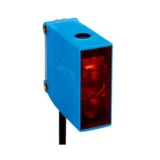
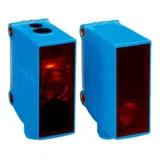
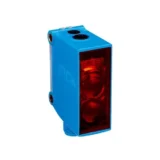
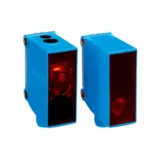
Description
SICK GTB10-P1212 PNP BGS Photoelectric Sensor
Technical Overview
The SICK GTB10-P1212 is a background-suppression photoelectric sensor with a PNP switching output and a visible red PinPoint LED. Its maximum sensing range is 20–950 mm on a white reference target having 90% remission, with actual usable distance dependent on the target surface. The 625 nm LED produces an 8 mm light spot at 700 mm, and a five-turn potentiometer adjusts the sensing setting. Background suppression helps distinguish the intended target from more distant surfaces. Selectable light/dark switching, response of no more than 500 µs, 1,000 Hz operation, a 2 m cable and IP67 plastic housing support machine integration.
PNP background-suppression sensor with 950 mm maximum reference-target range, 1,000 Hz switching, 2 m cable and IP67 housing.
Key Features
- Background suppression for target detection ahead of distant surfaces
- 20–950 mm maximum range on 90% remission reference white
- 625 nm visible red PinPoint LED
- Ø 8 mm light spot at 700 mm
- Five-turn sensing adjustment
- PNP output; selectable light/dark switching
- Response ≤ 500 µs; 1,000 Hz switching
- 10–30 V DC; 20 mA current consumption
- 2 m PVC cable with 0.14 mm² conductors
- IP67 ABS/PMMA housing; −30 to +60 °C operation
Technical Specification Matrix
| Parameter | Value |
|---|---|
| Functional principle | Photoelectric proximity sensor with background suppression |
| Maximum sensing range | 20–950 mm on 90% remission white target (DIN 5033) |
| Light source | PinPoint LED, visible red light |
| Wavelength | 625 nm |
| Light spot size | Ø 8 mm at 700 mm |
| Adjustment | Potentiometer, 5 turns |
| Conductor cross-section | 0.14 mm² |
| Power supply | 10–30 V DC; short-circuit-protected network, max. 8 A |
| Residual ripple | < 5 Vpp; remain within supply-voltage limits |
| Current consumption | 20 mA |
| Switching output | PNP |
| Switching mode | Light/dark switching; selectable via selector |
| Output current | ≤ 100 mA |
| Response time | ≤ 500 µs with resistive load |
| Switching frequency | 1,000 Hz at light/dark ratio 1:1 |
| Connection | 3-wire, 2 m PVC cable; do not bend below 0 °C |
| Circuit protection | Supply/input/output reverse-polarity protection, interference suppression and output overcurrent/short-circuit protection |
| Protection class | III |
| Housing form | Rectangular |
| Housing material | ABS/PMMA plastic |
| IP rating | IP67 |
| EMC standard | EN 60947-5-2 |
| Operating temperature | −30 to +60 °C |
| Storage temperature | −40 to +70 °C |
| UL file | NRKH.E348498 & NRKH7.E348498 |
| Conditional standard | UL325 when used with a sturdy protective hood, for example BEF-G10WSG (2071960) |
| MTTFD | 1,704 years |
| Diagnostic coverage DCavg | 0% |
| Wire assignment | CD-044: BN=L+; BU=M; BK=Q |
| Items supplied | BEF-G10DC01 mounting bracket |
| LED service life | Average 100,000 h at +25 °C |
| Target-specific ranges | White 90%: 100–950 mm sensing, 20–950 mm maximum; gray 18%: 100–675 mm sensing, 40–675 mm maximum; black 6%: 100–525 mm sensing, 60–525 mm maximum |
| Mounting | Ø4.2 mm mounting holes |
| Indicators | Green power-on indicator; yellow received-light status |
| Physical Weight (kg) | 0.09 |
Industrial Applications
1. Checking a workpiece ahead of a fixture background
An assembly fixture can present an opaque workpiece closer to the sensor than the structure behind it. The five-turn potentiometer establishes the intended sensing setting, while background suppression helps separate the target from farther surfaces. External control reads the PNP output after commissioning checks the actual target reflectance, spacing and placement tolerance against the target-specific range diagram.
A workpiece-presence reference helps assembly logic distinguish the loaded fixture condition, with adjustable background suppression and documented target-dependent ranges guiding the actual setup.
2. Counting separated components on a conveyor
A conveyor can carry separated components through a defined sensing location facing the red PinPoint beam. External counting logic evaluates the PNP switching signal, while setup checks component reflectance, height and gap against the documented optical ranges and timing. The stated 8 mm light spot at 700 mm gives a reference for assessing the actual feature presented at that working distance.
A discrete passage reference helps counting logic register separated components, with spot size, reflectance-dependent range and switching timing assessed for the actual conveyor arrangement.
3. Confirming a tray at a transfer stop
A transfer stop can present a tray surface within a commissioned detection zone and use background suppression to reduce responses from farther machine surfaces. External transfer logic reads the selected light/dark PNP state after the tray settles. Installation uses the mounting holes and supplied bracket, with actual tray reflectance and distance checked against the manufacturer range diagram.
A seated-tray reference helps transfer logic coordinate the next handling step, using an adjusted detection zone and target-dependent optical limits at the monitored stop.