Description
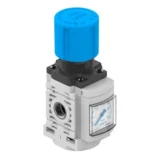
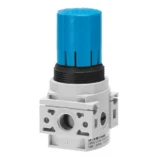
Festo LRP-1/4-4 Precision Pressure Regulator
Technical Overview
The Festo LRP-1/4-4 is a piloted precision diaphragm regulator providing constant output pressure over a 0.05–4 bar adjustment range. Maximum pressure hysteresis is specified as 0.02 bar, with 2000 l/min standard nominal flow and a 1–12 bar inlet-pressure range. Secondary exhausting provides a relief path on the regulated side, while a detented rotary knob forms the adjustment interface. The aluminium-bodied unit has G1/4 inlet and outlet connections and a prepared G1/8 gauge connection. It supports unlubricated compressed air or inert gas, front-panel or inline mounting, and −10 to 60 °C media and ambient temperatures.
G1/4 precision diaphragm regulator with 0.05–4 bar adjustment, 0.02 bar maximum hysteresis and secondary exhausting.
Key Features
- 0.05–4 bar pressure-regulation range
- 0.02 bar maximum pressure hysteresis
- Piloted precision diaphragm control-valve design
- Constant output pressure with secondary exhausting
- 2000 l/min standard nominal flow to DIN 1343
- 1–12 bar inlet-pressure range
- G1/4 inlet and outlet; prepared G1/8 pressure-gauge connection
- Rotary knob with detent; front-panel, inline or accessory mounting
- Unlubricated compressed air and inert-gas operating media
- 310 g product weight with aluminium housing and NBR seals
Technical Specification Matrix
| Parameter | Value |
|---|---|
| Actuator lock | Rotary knob with detent |
| Mounting position | Any |
| Design | Piloted precision diaphragm control valve |
| Controller function | Output pressure constant; With secondary exhausting |
| Pressure gauge (ANALOG) or Pressure display (DIGITAL) | Prepared for G1/8 |
| Operating pressure | 0.1 MPa...1.2 MPa; 1 bar...12 bar |
| Pressure regulation range | 0.05 bar...4 bar |
| Inlet pressure 1 | 1 bar...12 bar |
| Max. pressure hysteresis | 0.02 bar |
| Standard nominal flow rate (standardised to DIN 1343) | 2000 l/min |
| Operating medium | Compressed air to ISO 8573-1:2010 [7:4:4]; Inert gas |
| Note on operating and pilot medium | Lubricated operation not possible |
| LABS (PWIS) conformity | VDMA24364-B1/B2-L |
| Media temperature | -10 °C...60 °C |
| Ambient temperature | -10 °C...60 °C |
| Physical Weight (kg) | 0.31 |
| Type of mounting | Front panel mounting; Inline installation; With accessories |
| Pneumatic connection, port 1 | G1/4 |
| Pneumatic connection, port 2 | G1/4 |
| Note on materials | RoHS compliant |
| Material seals | NBR |
| Material housing | Aluminium |
Industrial Applications
1. Pressure Setting for a Light Clamping Fixture
A pneumatic assembly fixture needs a reduced working pressure for handling parts that require a light clamp setting. The 0.05–4 bar regulation range provides low-pressure adjustment at the fixture branch, while the piloted diaphragm design maintains the output-pressure function. The specified 0.02 bar maximum hysteresis characterises the regulator's pressure-setting behaviour without implying a complete fixture force-accuracy rating.
Local pressure reduction provides the clamp circuit with a suitable adjustment range, while the documented hysteresis helps characterise the regulator response during changes to the working-pressure setting.
2. Lowering a Test-Line Pressure Between Recipes
A pneumatic test station changes its downstream pressure between test recipes. The regulator's secondary-exhausting function gives the regulated side a relief path when the setpoint is reduced. A detented rotary knob provides manual adjustment, and the prepared G1/8 connection allows a separately selected pressure gauge to be incorporated into the test-line arrangement.
Secondary exhausting allows retained downstream pressure to decrease during a lower setpoint adjustment, supporting recipe changes through the same regulator used to establish the test pressure.
3. Regulated Inert-Gas Feed to a Process Fixture
A process fixture requires a reduced-pressure inert-gas feed rather than a direct connection to the upstream line. Festo lists inert gas as an operating medium for this regulator, alongside unlubricated compressed air. The G1/4 ports connect the regulated branch, and the 1–12 bar inlet and 0.05–4 bar output-setting ranges define its pressure-control envelope.
The regulator provides documented inert-gas pressure-reduction capability at the fixture feed, combining a defined input-pressure range with local output adjustment in one diaphragm-controlled component.