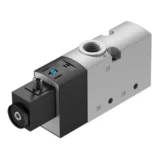
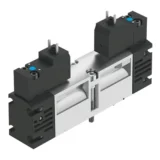
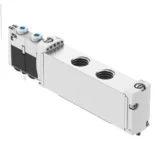
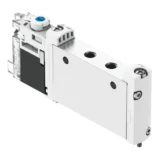
Description
Festo MHA2-MS1H-3/2O-2 Direct-Acting Solenoid Valve
Technical Overview
The Festo MHA2-MS1H-3/2O-2 is a direct-acting, normally open 3/2-way solenoid valve with mechanical spring reset and 100 l/min standard nominal flow. Its 10 mm body uses a sub-base interface, a 2 mm nominal passage and a 14 mm mounting grid with 4 mm minimum spacing between valves. At 24 V DC, specified switching times are 1.7 ms on and 2 ms off, with holding-current reduction and a two-pin plug. The normal pressure range is −0.9 to 8 bar, restricted to −0.9 to 1 bar for reversible operation. The 60 g IP65 assembly has temperature limits dependent on switching frequency.
Direct-acting normally open 3/2-way sub-base valve with 100 l/min nominal flow, 24 V DC actuation, 1.7 ms on/2 ms off timing and IP65.
Key Features
- Normally open single-solenoid 3/2-way function with mechanical spring reset
- Direct-acting pressure-relief poppet construction; 2 mm nominal size
- 100 l/min standard nominal flow to DIN 1343
- 10 mm construction width and 14 mm grid; 4 mm minimum inter-valve spacing
- −0.9 to 8 bar operating range; reversible operation restricted to −0.9 to 1 bar
- 1.7 ms on and 2 ms off switching; +10%/−30% switching-time tolerances
- 330 Hz maximum switching frequency, subject to frequency-dependent temperature limits
- 24 V DC two-pin plug; coil high-current phase 5.0 W and low-current phase 1.25 W
- Holding-current reduction, spark arresting, protective circuit and bipolar reverse-polarity protection
- 60 g product weight, IP65, non-detenting manual override and Class 6 cleanroom suitability
Technical Specification Matrix
| Parameter | Value |
|---|---|
| Valve function | 3/2-way, single solenoid, open |
| Type of actuation | Electrical |
| Construction width | 10 mm |
| Standard nominal flow rate (standardised to DIN 1343) | 100 l/min |
| pneumatic working port | Sub-base |
| Operating voltage | 24 V DC |
| Operating pressure | -0.09 MPa...0.8 MPa; -0.9 bar...8 bar; -13.05 psi...116 psi |
| Design | Pressure relief poppet valve |
| Type of reset | Mechanical spring |
| Degree of protection | IP65 |
| Approval | RCM; c UL us - Recognised (Oil) |
| CE mark (see declaration of conformity) | To EU EMC Directive; In accordance with EU RoHS Directive |
| UKCA marking (see declaration of conformity) | To UK instructions for EMC; To UK RoHS instructions |
| Nominal size | 2 mm |
| Mounting grid pitch | 14 mm |
| Minimum inter-valve spacing | Minimum distance between the valves is 4 mm |
| Exhaust-air function | Can be throttled |
| Sealing principle | Soft |
| Mounting position | Any |
| Manual override | Non-detenting |
| Type of piloting | Direct |
| Flow direction | Reversible with restrictions |
| lap | Underlap |
| Reverse polarity protection | Bipolar |
| Additional functions | Spark arresting; Holding current reduction; Protective circuit |
| Operating pressure, reversible | -0.09 MPa...0.1 MPa; -0.9 bar...1 bar; -13.05 psi...14.5 psi |
| Max. switching frequency | 330 Hz |
| Switching time off | 2 ms |
| Switching time on | 1.7 ms |
| Tolerance switching time off | +10%/-30% |
| Tolerance switching time on | +10%/-30% |
| Switching time dispersion from 1 Hz | 0.2 ms |
| Duty cycle | 100% |
| Characteristic coil data | 24 V DC: low-current phase 1.25 W, high-current phase 5.0 W |
| Permissible voltage fluctuations | +/-10% |
| Operating medium | Compressed air to ISO 8573-1:2010 [7:4:4] |
| Note on operating and pilot medium | Lubricated operation possible (in which case lubricated operation will; always be required) |
| Vibration resistance | Transport application test with severity level 2 to FN 942017-4 and EN; 60068-2-6 |
| Restrictions for environmental and media temperature | As a function of switching frequency (see graph) |
| Shock resistance | Shock test with severity level 2 to FN 942017-5 and EN 60068-2-27 |
| Corrosion resistance class CRC | 2 - Moderate corrosion stress |
| LABS (PWIS) conformity | VDMA24364-B1/B2-L |
| Cleanroom suitability, measured according to ISO 14644-14 | Class 6 according to ISO 14644-1 |
| Media temperature | -5 °C...40 °C |
| Ambient temperature | -5 °C...40 °C |
| Physical Weight (kg) | 0.06 |
| Electrical connection | 2-pin; Plug |
| Type of mounting | On sub-base |
| Pneumatic connection, port 11 | Sub-base |
| Pneumatic connection, port 2 | Sub-base |
| Pneumatic port 33 | Sub-base |
| Note on materials | RoHS compliant |
| Material seals | HNBR; NBR |
| Material housing | Die-cast zinc, coated |
| Material screws | Galvanised steel |
Industrial Applications
1. Interrupting Airflow to a Small Process Nozzle
A process station normally supplies a small air nozzle and needs an electrical command to interrupt its feed. The normally open 3/2-way valve supplies the unactuated flow arrangement, with direct actuation and specified 1.7 ms on/2 ms off component switching times. Its 100 l/min nominal flow characterizes the valve, while the nozzle response depends on the connected volume and tubing.
The normally open routing supports the default feed condition, while direct electrical switching provides a defined command point for interrupting or changing that pneumatic path.
2. Electrical Commands to a Pneumatic Pilot Circuit
An automated fixture uses a downstream pneumatic control element and needs an electrical-to-pneumatic command stage. This direct-acting 3/2 valve switches its working path from a 24 V DC command and returns by mechanical spring. Sub-base connections group the supply, working and exhaust interfaces at the valve station, while the two-pin plug defines the electrical connection.
The valve converts an electrical sequence command into a pneumatic switching state, with direct actuation and mechanical spring reset providing the command stage for the downstream circuit.
3. Restricted-Pressure Vacuum Path Switching
A handling circuit requires a small directional valve whose working paths can operate below atmospheric pressure. Festo permits reversible operation for this model within the restricted −0.9 to 1 bar pressure range, distinct from its ordinary −0.9 to 8 bar rating. The direct-acting design switches without a separate pilot-air pressure requirement, with the sub-base providing the three pneumatic interfaces.
Documented reversible low-pressure operation provides a valve basis for a vacuum-path circuit, while direct actuation avoids introducing a separate pneumatic pilot supply to switch that component.