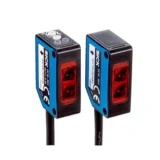
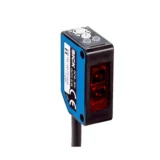
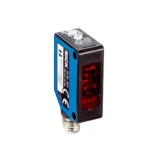
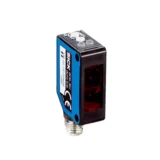
Description
SICK WL100-2N4429 Transparent-object Retro-reflective Sensor
Technical Overview
The SICK WL100-2N4429 is a retro-reflective photoelectric sensor specified for detecting transparent objects with at least 20% attenuation along the light beam. Its dual-lens system requires a minimum reflector distance and provides 0.01–2.5 m sensing and 0.01–3 m maximum range with PL80A. The 632 nm red LED produces a 140 mm spot at 2 m. A sensitivity potentiometer and separate light/dark rotary switch establish the NPN switching condition. Response is no more than 0.5 ms with resistive load, with 1,000 Hz switching at a 1:1 light/dark ratio. The rectangular ABS/PC/POM housing uses PMMA optics, an M8 four-pin male connector and IP67 protection. A BEF-W100-A bracket and P250 reflector are supplied.
Transparent-object retro-reflective sensor with 0.01–2.5 m PL80A sensing, ≥20% beam attenuation, selectable NPN switching and M8 four-pin connection.
Key Features
- Dual-lens retro-reflective detection; minimum reflector distance
- Transparent-object detection with ≥20% attenuation along the light beam
- 0.01–2.5 m sensing and 0.01–3 m maximum range with PL80A reflector
- 632 nm visible red LED; Ø140 mm spot at 2 m
- Sensitivity potentiometer and separate light/dark rotary switch
- NPN switching output; maximum current ≤100 mA
- ≤0.5 ms response with resistive load; 1,000 Hz at 1:1 light/dark ratio
- 10–30 V DC; 30 mA without load; M8 four-pin male connector
- ABS/PC/POM housing; PMMA optics; IP67; −25 to +55 °C operation
- BEF-W100-A mounting bracket and P250 reflector included
Technical Specification Matrix
| Parameter | Value |
|---|---|
| Functional principle | Photoelectric retro-reflective sensor; dual-lens system with minimum reflector distance |
| Housing design | Rectangular |
| Sensing range | 0.01–2.5 m with PL80A reflector |
| Maximum sensing range | 0.01–3 m with PL80A reflector |
| Light source | Visible red LED |
| Wavelength | 632 nm |
| Light spot size | Ø140 mm at 2 m |
| LED service life | Average 100,000 h at ambient +25 °C |
| Adjustment | Sensitivity potentiometer |
| Digital output | NPN switching output; maximum current ≤100 mA |
| Switching mode | Light/dark switching, selectable via rotary switch (L=light; D=dark) |
| Signal voltage HIGH/LOW | Approximately supply voltage / <1.8 V |
| Response time | ≤0.5 ms signal transit time with resistive load |
| Switching frequency | 1,000 Hz at 1:1 light/dark ratio |
| Power supply | 10–30 V DC, limit values |
| Residual ripple | ±10%; remain within supply tolerances |
| Protection class | III |
| Circuit protection | A: supply reverse-polarity protection; B: output reverse-polarity protection; D: outputs overcurrent and short-circuit protection |
| Housing material | ABS/PC/POM plastic |
| Optics material | PMMA plastic |
| Connection | M8 four-pin male connector |
| Mounting | M3 threaded mounting holes |
| IP rating | IP67 |
| Operating temperature | −25 to +55 °C |
| Storage temperature | −40 to +70 °C |
| Orange LED indicator | Switching output active |
| Green LED indicator | Power on |
| Current consumption | 30 mA without load |
| MTTFD | 954 years |
| DCavg | 0% |
| Alternative reflector ranges | P250, PL50A or PL40A: 0.01–2 m sensing / 0.01–2.4 m maximum; PL30A or PL31A: 0.01–1.8 m / 0.01–2.2 m; PL20A: 0.01–1.2 m / 0.01–1.5 m; Diamond Grade tape: 0.2–1 m / 0.2–1.1 m; P45: 0.01–0.7 m / 0.01–0.8 m. Close-up ranges apply at maximum sensitivity. |
| Pin assignment | 1 BN=L+; 2 WH=not connected; 3 BU=M; 4 BK=Q (CD-067) |
| Items supplied | One BEF-W100-A mounting bracket and one P250 reflector |
| Special application | Detecting transparent objects |
| Attenuation along light beam | ≥20% |
Industrial Applications
1. Counting separated transparent bottles
A bottle conveyor can place the sensor opposite a reflector so separated transparent bottles attenuate the returned red beam. The sensitivity potentiometer establishes detection using representative bottles that meet the specified ≥20% beam-attenuation condition. External counting logic evaluates the NPN state after checking bottle orientation, clear gaps and transit speed against the response and switching-frequency limits.
A bottle-passage reference helps external counting logic track separated transparent containers, using attenuation of a reflected beam with electrical wiring concentrated on the sensor side.
2. Checking a transparent tray in a loading nest
A loading nest can present a transparent tray between the sensor and reflector at a repeatable position. The sensitivity potentiometer establishes the loaded and empty optical conditions with actual tray samples, using material and geometry that provide at least 20% beam attenuation. External inspection logic samples the switching state after the tray reaches its mechanical presentation position.
A tray-present reference helps external loading logic distinguish an occupied nest from an empty location, supporting a missing-tray check before the next loading operation begins.
3. Monitoring continuity of a transparent material web
A web feeder can route a transparent material strip between the sensor and a reflector so loss of the web changes the received-light condition. Setup uses representative material that provides the required ≥20% attenuation and checks the installed reflector distance. The light/dark rotary switch selects the output behavior used by external feed logic to recognize a sustained change.
A web-continuity reference helps external feed logic identify a break or exhausted material path, using the difference between attenuated and unobstructed reflected light to coordinate its response.