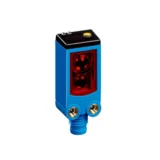
Description
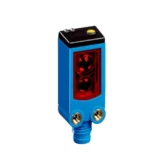
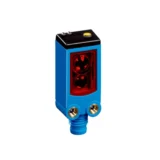
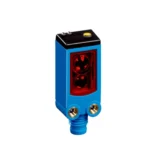
SICK WLG4-3E1332 NPN Transparent-object Retro-reflective Sensor
Technical Overview
The SICK WLG4-3E1332 is a flat photoelectric retro-reflective sensor for transparent-object detection. Polarized optics provide a 0.02–3.5 m sensing range with PL80A and a maximum reach of 4.5 m. A 650 nm visible red PinPoint LED produces a 75 mm spot at 1.5 m. A single teach-in button adjusts detection, with production-week-dependent button modes and AutoAdapt behavior specified in the datasheet. The NPN dark-switching output connects to external control. Response is below 0.5 ms under resistive load, with 1,000 Hz switching at a 1:1 light/dark ratio. The ABS housing has a PMMA front screen, M3 threaded mounting holes, IP66/IP67 protection and a 2 m three-wire PVC cable.
Transparent-object retro-reflective sensor with 0.02–3.5 m PL80A range, teach-in, AutoAdapt, NPN dark switching and 2 m three-wire PVC cable.
Key Features
- Polarized retro-reflective sensing for transparent objects
- 0.02–3.5 m sensing range with PL80A; maximum reach 4.5 m
- 650 nm visible red PinPoint LED; Ø75 mm spot at 1.5 m
- Single teach-in button; select teach mode by production week
- AutoAdapt; clear-object mode from week 01/2013 uses an 8% threshold with continuous adaptation
- NPN dark-switching output, ≤100 mA
- <0.5 ms response with resistive load; 1,000 Hz at 1:1 light/dark ratio
- 10–30 V DC; 20 mA without load
- 2 m three-wire PVC cable; M3 threaded mounting holes
- ABS housing, PMMA front screen, IP66/IP67; −40 to +60 °C operation
Technical Specification Matrix
| Parameter | Value |
|---|---|
| Functional principle | Photoelectric retro-reflective sensing with polarization filter |
| Special application | Detecting transparent objects |
| Sensing range | 0.02–3.5 m with PL80A reflector |
| Maximum sensing range | Up to 4.5 m with PL80A reflector |
| Light source | Visible red PinPoint LED |
| Wavelength | 650 nm |
| Light spot size | Ø75 mm at 1.5 m |
| LED service life | Average 100,000 h at ambient +25 °C |
| Adjustment | Single teach-in button; mode depends on production week |
| AutoAdapt | Yes |
| Digital output | NPN dark-switching output; maximum output current ≤100 mA |
| Switching mode | Dark switching |
| Pin assignment | BN=L+; BU=M; BK=Q (CD-043) |
| Response time | <0.5 ms signal transit time with resistive load |
| Switching frequency | 1,000 Hz at 1:1 light/dark ratio |
| Power supply | 10–30 V DC, limit values |
| Residual ripple | <5 Vpp; remain within supply tolerances |
| Current consumption | 20 mA without load |
| Circuit protection | A: supply reverse-polarity protection; C: interference suppression; D: outputs overcurrent and short-circuit protection |
| Polarization filter | Yes |
| Housing design | Flat, rectangular |
| Housing material | ABS plastic |
| Connection | 2 m three-wire PVC cable; do not bend below 0 °C |
| Mounting provisions | M3 threaded mounting holes |
| IP rating | IP66/IP67 |
| Operating temperature | −40 to +60 °C |
| Storage temperature | −40 to +75 °C |
| Teach modes from production week 01/2013 | 2 s button press: clear-object mode, 8% threshold with continuous threshold adaptation; 8 s: standard mode, 50% threshold |
| Teach modes before production week 01/2013 | 2 s button press: 50% threshold without continuous threshold adaptation; 8 s: clear-object mode, 10% threshold |
| Attenuation along light beam | >8% |
| Protection class | III |
| Front screen | PMMA plastic |
| Physical Weight (kg) | 0.03 |
| Conductor cross-section | 0.14 mm² |
| Cable diameter | Ø3.4 mm |
Industrial Applications
1. Counting separated clear containers
A packaging feeder can mount the sensor opposite a PL80A reflector so separated clear containers pass through the reflected-light path. Single-button teach-in establishes detection using actual container material, wall shape and contents. External counting logic evaluates the NPN dark-switching output, with spacing and sampling checked against the 1,000 Hz specification at a 1:1 light/dark ratio and the 0.02–3.5 m PL80A sensing range.
A transparent-container passage reference helps external counting logic track clear products whose transmitted light makes ordinary opaque-object detection unsuitable, after actual container presentation and separation have been verified.
2. Confirming a clear carrier at a transfer stop
A compact transfer station can align the sensor and PL80A reflector across a defined wall of a clear carrier at its seated position. Polarized optics evaluate the reflector return, and the 2 m three-wire PVC cable supports local installation. Setup teaches using representative carriers and verifies that nearby machine features remain outside the intended optical path throughout carrier movement.
A clear-carrier position reference helps external transfer control recognize arrival at the intended location, supporting coordinated upstream release after carrier wall geometry and the seated position have been checked.
3. Checking a transparent cover on a presented assembly
An assembly nest can present a transparent cover across the reflected-light path at a defined inspection point. Single-button teach-in establishes detection with representative covered and uncovered assemblies, while the transparent-object sensing function evaluates the cover condition. External inspection logic samples the switching output at the intended stage after verifying cover material, curvature, presentation tolerance and nearby background interference on the actual assembly.
A cover-present reference helps external inspection logic identify an assembly missing its transparent cover, reducing the chance that a cover omission proceeds unnoticed to the following operation.