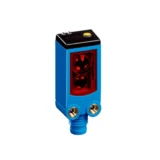
Description
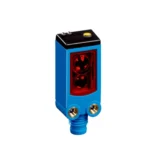
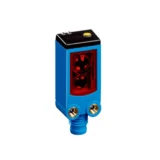
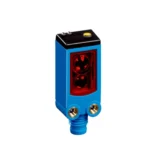
SICK WLG4-3F1482S04 PNP Transparent-object Retro-reflective Sensor
Technical Overview
The SICK WLG4-3F1482S04 is a flat photoelectric retro-reflective sensor for transparent-object detection. Its 0.02–0.4 m sensing range and 0.01–1.5 m maximum range are specified with a PL80A reflector. A stainless steel surface can also serve as the reflector, with suitability checked on the installed surface. The 650 nm visible red PinPoint LED produces a 25 mm spot at 200 mm. A single teach-in button adjusts detection, and AutoAdapt is provided. The PNP dark-switching output responds below 0.5 ms under resistive load, with 1,000 Hz switching at a 1:1 light/dark ratio. A 5 m three-wire PVC cable connects the IP67 ABS/PMMA housing to external control.
Transparent-object retro-reflective sensor with 0.02–0.4 m PL80A range, teach-in, AutoAdapt, PNP dark switching and 5 m three-wire PVC cable.
Key Features
- Retro-reflective transparent-object detection; stainless steel surface can serve as reflector
- 0.02–0.4 m sensing range with PL80A; maximum reach 1.5 m
- 650 nm visible red PinPoint LED; Ø25 mm spot at 200 mm
- Single teach-in button for detection adjustment
- AutoAdapt function
- PNP dark-switching output, ≤100 mA
- <0.5 ms response with resistive load; 1,000 Hz at 1:1 light/dark ratio
- 10–30 V DC; 20 mA without load
- 5 m three-wire PVC cable; M3 threaded mounting holes
- ABS housing, PMMA front screen, IP67; −40 to +60 °C operation
Technical Specification Matrix
| Parameter | Value |
|---|---|
| Functional principle | Photoelectric retro-reflective sensing |
| Special application | Detecting transparent objects |
| Sensing range | 0.02–0.4 m with PL80A reflector |
| Maximum sensing range | 0.01–1.5 m with PL80A reflector |
| Light source | Visible red PinPoint LED |
| Wavelength | 650 nm |
| Light spot size | Ø25 mm at 200 mm |
| LED service life | Average 100,000 h at ambient +25 °C |
| Adjustment | Single teach-in button |
| AutoAdapt | Yes |
| Digital output | PNP dark-switching output; maximum output current ≤100 mA |
| Switching mode | Dark switching |
| Pin assignment | BN=L+; BU=M; BK=Q (CD-043) |
| Response time | <0.5 ms signal transit time with resistive load |
| Switching frequency | 1,000 Hz at 1:1 light/dark ratio |
| Power supply | 10–30 V DC, limit values |
| Residual ripple | <5 Vpp; remain within supply tolerances |
| Current consumption | 20 mA without load |
| Circuit protection | A: supply reverse-polarity protection; C: interference suppression; D: outputs overcurrent and short-circuit protection |
| Housing design | Flat, rectangular |
| Housing material | ABS plastic |
| Connection | 5 m three-wire PVC cable; do not bend below 0 °C |
| Mounting provisions | M3 threaded mounting holes |
| IP rating | IP67 |
| Operating temperature | −40 to +60 °C |
| Storage temperature | −40 to +75 °C |
| Attenuation along light beam | >8% |
| Protection class | III |
| Front screen | PMMA plastic |
| Physical Weight (kg) | 0.03 |
| Conductor cross-section | 0.14 mm² |
| Cable diameter | Ø3.4 mm |
| Special feature | Stainless steel surface can be used as reflector |
Industrial Applications
1. Counting separated clear containers
A packaging feeder can mount the sensor opposite a PL80A reflector so separated clear containers pass through the reflected-light path. Single-button teach-in establishes detection using actual container material, wall shape and contents. External counting logic evaluates the PNP dark-switching output, with spacing and sampling checked against the 1,000 Hz specification at a 1:1 light/dark ratio and the 0.02–0.4 m PL80A sensing range.
A transparent-container passage reference helps external counting logic track clear products whose transmitted light makes ordinary opaque-object detection unsuitable, after actual container presentation and separation have been verified.
2. Confirming a clear carrier at a transfer stop
A compact transfer station can align the sensor and PL80A reflector across a defined wall of a clear carrier at its seated position. Retro-reflective optics evaluate the reflector return, and the 5 m three-wire PVC cable supports local installation. Setup teaches using representative carriers and verifies that nearby machine features remain outside the intended optical path throughout carrier movement.
A clear-carrier position reference helps external transfer control recognize arrival at the intended location, supporting coordinated upstream release after carrier wall geometry and the seated position have been checked.
3. Checking a transparent cover on a presented assembly
An assembly nest can present a transparent cover across the reflected-light path at a defined inspection point. Single-button teach-in establishes detection with representative covered and uncovered assemblies, while the transparent-object sensing function evaluates the cover condition. External inspection logic samples the switching output at the intended stage after verifying cover material, curvature, presentation tolerance and nearby background interference on the actual assembly.
A cover-present reference helps external inspection logic identify an assembly missing its transparent cover, reducing the chance that a cover omission proceeds unnoticed to the following operation.