Description
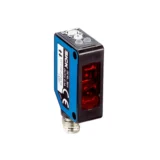
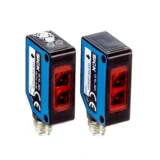
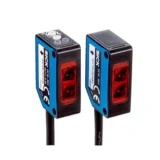
SICK WS/WE100-2N1439 NPN Through-Beam Sensor Set
Technical Overview
The SICK WS/WE100-2N1439 is a through-beam photoelectric sensor set with a NPN switching output and visible red LED illumination. Its separate sender and receiver detect opaque objects by interruption of the optical path, with a specified sensing range of 0–20 m and a maximum range of 33 m. A 270° sensitivity potentiometer adjusts reception for the installation, while a rotary selector provides light/dark switching. Response time is no more than 0.5 ms and switching frequency is 1,000 Hz. Two stainless steel mounting brackets, 2 m PVC connection cables, 10–30 V DC power and IP67 plastic housings support conveyor and material-handling integration.
NPN through-beam sensor set with 0–20 m sensing range, 1,000 Hz switching, 2 m cables and two mounting brackets.
Key Features
- Through-beam detection with separate sender and receiver
- 0–20 m sensing range; 33 m maximum range
- 632 nm visible red LED illumination
- NPN output with selectable light/dark switching
- 270° sensitivity potentiometer
- Response ≤ 0.5 ms; 1,000 Hz switching frequency
- 10–30 V DC power
- 2 m PVC cables with 0.18 mm² conductors
- IP67 ABS/PC/POM housings
- Two BEF-W100-A stainless steel mounting brackets supplied
Technical Specification Matrix
| Parameter | Value |
|---|---|
| Functional principle | Through-beam photoelectric sensor |
| Sensing range | 0–20 m |
| Maximum sensing range | 0–33 m |
| Light source | LED, visible red light |
| Wavelength | 632 nm |
| Light spot size | Ø 850 mm at 12 m |
| Adjustment | 270° sensitivity potentiometer |
| Sender current consumption | ≤ 15 mA without load |
| Receiver current consumption | ≤ 20 mA without load |
| Power supply | 10–30 V DC |
| Residual ripple | ±10%; remain within supply-voltage limits |
| Switching output | NPN |
| Switching mode | Light/dark switching; selectable via rotary switch |
| Output current | ≤ 100 mA |
| Response time | ≤ 0.5 ms with resistive load |
| Switching frequency | 1,000 Hz at light/dark ratio 1:1 |
| Connection | 3-wire, 2 m PVC cable; do not bend below 0 °C |
| Conductor cross-section | 0.18 mm² |
| Circuit protection | Supply/output reverse-polarity protection; output overcurrent and short-circuit protection |
| Protection class | III |
| Housing form | Rectangular |
| Housing material | ABS/PC/POM plastic |
| Optics material | PMMA plastic |
| IP rating | IP67 |
| Operating temperature | −25 to +55 °C |
| Storage temperature | −40 to +70 °C |
| Output signal voltage | Approximately supply voltage / < 1.8 V (HIGH/LOW) |
| Items supplied | Two BEF-W100-A stainless steel (1.4301/304) mounting brackets |
| MTTFD | 782 years |
| Diagnostic coverage DCavg | 0% |
| Dimensions L x W x H (cm) | 2 x 1.1 x 3.1 |
Industrial Applications
1. Carton counting across a conveyor
On a conveyor carrying separated opaque cartons, the sender and receiver face each other across the belt. Each carton interrupts the red beam, producing an NPN switching signal for the machine counter. The 0–20 m sensing range accommodates wide conveyor arrangements, while the specified response of no more than 0.5 ms supports detection of distinct passing edges.
Beam interruption provides a count event without depending on reflected light from the carton surface, giving the conveyor controller a direct signal for tracking separated loads.
2. Monitoring material continuity on a feed line
A film or sheet feeder handling opaque material can place the optical beam across the expected material path. The received-light state changes when material runs out or a break leaves an opening in that path. Selectable light/dark switching lets the control system use the appropriate signal polarity, while sensitivity adjustment sets the receiver for the installed separation.
A persistent change in beam reception identifies loss of material continuity, allowing the machine controller to respond before subsequent processing continues without material in place.
3. Detecting accumulation at a conveyor transfer
At a transfer between conveyors, an opaque load that remains across the beam indicates that the receiving position is occupied. The sender and receiver can span the transfer area without a reflector. IP67 housings suit exposed machine locations, and the 2 m cables connect the optical pair to the local machine wiring for occupancy monitoring.
The controller can distinguish a brief passing load from sustained blockage using signal duration, helping coordinate upstream release when the downstream transfer point remains occupied.