Description
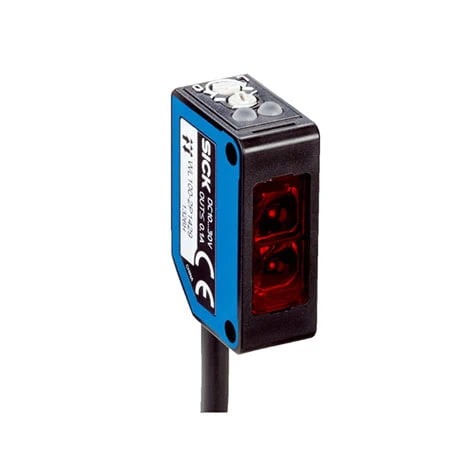
SICK WL100-2N1429 NPN Transparent-Object Sensor
Technical Overview
The SICK WL100-2N1429 is a retro-reflective photoelectric sensor for transparent objects that attenuate the optical beam by at least 20%. A 632 nm visible red LED illuminates a reflector, and the receiver evaluates the returned light as the target enters the beam. A sensitivity potentiometer and selectable light/dark switching adapt the NPN signal to the machine. The specified 0.01–2.5 m sensing range and 3 m maximum range use a PL80A reflector; distance depends on reflector choice. A P250 reflector and BEF-W100-A bracket are supplied, alongside a 2 m cable and IP67 housing for equipment integration.
NPN retro-reflective sensor for transparent targets with ≥20% beam attenuation, sensitivity adjustment, 2 m cable and supplied reflector.
Key Features
- Transparent-object detection with ≥20% beam attenuation
- Dual-lens retro-reflective optical system
- 0.01–2.5 m sensing range; 3 m maximum with PL80A reflector
- 632 nm visible red LED; Ø 140 mm spot at 2 m
- Sensitivity potentiometer
- NPN output with selectable light/dark switching
- Response ≤ 0.5 ms; 1,000 Hz switching frequency
- 10–30 V DC supply and 2 m PVC cable
- IP67 ABS/PC/POM housing
- BEF-W100-A bracket and P250 reflector supplied
Technical Specification Matrix
| Parameter | Value |
|---|---|
| Functional principle | Photoelectric retro-reflective sensor with minimum reflector distance, dual-lens system |
| Sensing range | 0.01–2.5 m with PL80A reflector |
| Maximum sensing range | 0.01–3 m with PL80A reflector |
| Light source | LED, visible red light |
| Wavelength | 632 nm |
| Light spot size | Ø 140 mm at 2 m |
| Adjustment | Sensitivity potentiometer |
| Special application | Detecting transparent objects |
| Required beam attenuation | ≥ 20% |
| Current consumption | 30 mA without load |
| Power supply | 10–30 V DC |
| Residual ripple | ±10%; remain within supply-voltage limits |
| Switching output | NPN |
| Switching mode | Light/dark switching; selectable via rotary switch |
| Output current | ≤ 100 mA |
| Response time | ≤ 0.5 ms with resistive load |
| Switching frequency | 1,000 Hz at light/dark ratio 1:1 |
| Connection | 3-wire, 2 m PVC cable; do not bend below 0 °C |
| Conductor cross-section | 0.18 mm² |
| Circuit protection | Supply/output reverse-polarity protection; output overcurrent and short-circuit protection |
| Protection class | III |
| Housing form | Rectangular |
| Housing material | ABS/PC/POM plastic |
| Optics material | PMMA plastic |
| IP rating | IP67 |
| Operating temperature | −25 to +55 °C |
| Storage temperature | −40 to +70 °C |
| Output signal voltage | Approximately supply voltage / < 1.8 V (HIGH/LOW) |
| Items supplied | BEF-W100-A mounting bracket and P250 reflector |
| MTTFD | 954 years |
| Diagnostic coverage DCavg | 0% |
| Dimensions L x W x H (cm) | 2 x 1.1 x 3.1 |
Industrial Applications
1. Counting clear containers on a packaging line
A packaging conveyor needs a switching event for each separated clear container even though the container transmits some light. The sensor evaluates attenuation in the beam returned by a reflector rather than requiring complete blockage. With containers producing at least 20% beam attenuation, the sensitivity potentiometer sets the detection threshold and the switching output supplies count events to the controller.
The sensor converts a qualifying reduction in returned light into a discrete event, allowing the machine to count transparent containers that do not fully block an ordinary optical path.
2. Monitoring transparent film continuity
A film feeder can monitor a fixed location where a transparent web crosses the beam between sensor and reflector. Film that reduces the returned beam by at least 20% creates a detectable state relative to the empty path. Sensitivity adjustment accommodates the installed optical path, and light/dark switching provides the chosen electrical logic for a web-present or web-missing signal.
Loss of the qualifying film attenuation changes the switching state when the web runs out or breaks, giving the feeder controller an electrical indication of interrupted material supply.
3. Detecting accumulation of transparent trays
At a packaging transfer, a transparent tray remaining between sensor and reflector can indicate that the downstream position is occupied. The tray must attenuate the beam by at least 20% for this sensing mode. The machine controller evaluates how long the signal persists, while IP67 protection and a 2 m cable support mounting beside the transfer mechanism.
A sustained attenuation signal lets the controller identify a tray held at the transfer point, helping coordinate upstream release when transparent packaging remains in the monitored position.