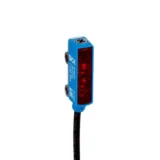
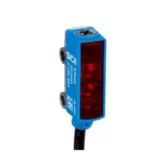
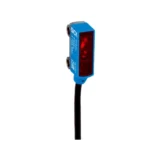
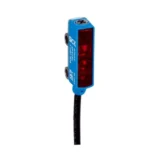
Description
SICK GTB2S-N1311 NPN Miniature BGS Sensor
Technical Overview
The SICK GTB2S-N1311 is a miniature photoelectric proximity sensor with background suppression and an NPN light-switching output. Its 640 nm visible red PinPoint LED forms a 2 mm spot at 8 mm, supporting defined optical detection points in compact machinery. The specified sensing range is 4–15 mm on a target with 6% remission, while the 1–18 mm maximum range applies to a white target with 90% remission. No sensitivity adjustment is provided, and background suppression begins typically at 20 mm. A response below 0.6 ms, 800 Hz switching frequency, 2 m PVC cable and IP67 ABS housing support machine integration.
NPN background-suppression sensor with 4–15 mm sensing on a 6% remission target, 800 Hz switching, 2 m cable and IP67 housing.
Key Features
- Photoelectric sensing with background suppression
- 4–15 mm sensing range on a 6% remission target
- 1–18 mm maximum range on 90% remission reference white
- 640 nm visible red PinPoint LED
- Ø 2 mm spot at 8 mm
- NPN light switching; no sensitivity adjustment
- Response < 0.6 ms; 800 Hz switching
- 10–30 V DC; 20 mA current consumption without load
- 2 m PVC cable, 3 mm diameter
- IP67 ABS housing; −25 to +50 °C operation
Technical Specification Matrix
| Parameter | Value |
|---|---|
| Functional principle | Photoelectric proximity sensor with background suppression |
| Sensing range | 4–15 mm on a target with 6% remission |
| Maximum sensing range | 1–18 mm on a 90% remission white target (DIN 5033) |
| Background suppression | Typically from 20 mm |
| Light source | PinPoint LED, visible red light |
| Wavelength | 640 nm |
| Light spot size | Ø 2 mm at 8 mm |
| Adjustment | None |
| Special application | Detecting small objects |
| Power supply | 10–30 V DC; short-circuit-protected network, max. 8 A |
| Residual ripple | < 5 Vpp; remain within supply-voltage limits |
| Current consumption | 20 mA without load |
| Switching output | NPN |
| Switching mode | Light switching |
| Output current | ≤ 50 mA |
| Response time | < 0.6 ms with resistive load |
| Switching frequency | 800 Hz at light/dark ratio 1:1 |
| Connection | 3-wire, 2 m PVC cable; do not bend below 0 °C |
| Cable diameter | 3 mm |
| Circuit protection | Supply reverse-polarity protection, interference suppression and output overcurrent/short-circuit protection |
| Housing form | Rectangular |
| Housing material | ABS plastic |
| Optics material | PMMA plastic |
| IP rating | IP67 |
| Operating temperature | −25 to +50 °C |
| Storage temperature | −40 to +75 °C |
| UL file | NRKH.E181493 |
| MTTFD | 3,378 years |
| Diagnostic coverage DCavg | 0% |
| Dimensions L x W x H (cm) | 1.35 x 0.77 x 2.18 |
| Physical Weight (kg) | 0.0337 |
Industrial Applications
1. Workpiece detection in front of a machine frame
An assembly fixture must detect an opaque workpiece without responding to a structure farther behind it. Background suppression separates the intended near target from more distant surfaces within the documented operating geometry. The 4–15 mm sensing range on a target with 6% remission and fixed optical configuration support a defined detection position, while the NPN output supplies the workpiece signal to the controller.
Distance-based background rejection reduces unwanted detections from the machine structure behind the fixture, giving the sequence controller a clearer indication that the intended workpiece occupies the sensing point.
2. Counting separated components on a conveyor
A narrow conveyor carrying separated components needs a switching event at each passing part. The sensor directs a red spot of approximately 2 mm diameter at 8 mm toward the detection point. Background suppression helps distinguish the raised components from a more distant belt surface, and the 800 Hz switching frequency supports repeated transitions within the specified operating limits.
A defined optical spot and background rejection help isolate component passages from the belt behind them, supporting repeatable count events without mechanical contact with the moving parts.
3. Checking tray seating before a handling cycle
A handling station can direct the sensor toward the expected edge of a seated opaque tray. The short sensing range establishes a local presence check, while background suppression limits responses from surfaces farther away when the tray is absent. The response below 0.6 ms supplies a prompt input transition, and the NPN light-switching output reports target detection.
A contactless tray-position signal helps the controller distinguish an occupied pickup location from an empty station, supporting coordinated handling without a mechanical feeler at the tray edge.