Description
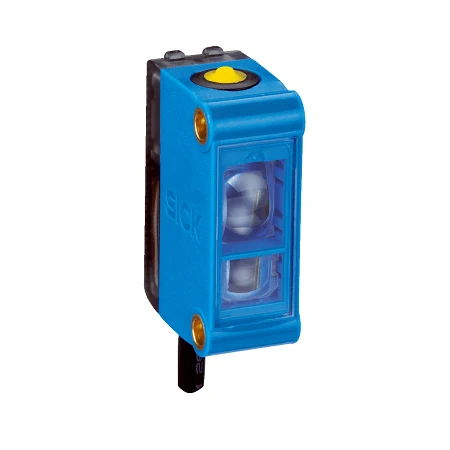
SICK CSM-WP11122P PNP Single-Color Sensor
Technical Overview
The SICK CSM-WP11122P is a compact RGB color sensor with one taught-color channel and a PNP switching output. Static one-point teach-in learns the target color, and the operator selects precise, medium or coarse color tolerance using the local button and emitted-light indication. The sensor emits from the long housing side with a 1.5 × 6.5 mm vertical spot, at a specified sensing distance up to 12.5 mm with ±3 mm tolerance. It provides 1.7 kHz switching, 300 µs response and an external teach input. A 0.2 m PVC cable with M12 four-pin plug and an IP67 ABS housing support compact machine installation.
RGB single-color sensor with PNP output, static one-point teach-in, selectable color tolerance, 1.7 kHz switching and a 0.2 m M12 connection cable.
Key Features
- RGB LED color sensing at 640, 525 and 470 nm
- One taught-color output channel
- Sensing distance ≤12.5 mm with ±3 mm tolerance
- Long-side emission; 1.5 × 6.5 mm vertical light spot
- Static one-point teach-in using the local button
- Precise, medium and coarse color-tolerance selections
- PNP output with external teach input
- 1.7 kHz switching; 300 µs response and 150 µs jitter
- 0.2 m PVC cable with M12 four-pin plug
- IP67 ABS housing with PMMA optics; approximate 25 g product weight
Technical Specification Matrix
| Parameter | Value |
|---|---|
| Functional principle | Optical color detection |
| Housing design | Small |
| Light source | LED, RGB |
| Wavelengths | 640 nm, 525 nm and 470 nm |
| Light emission | Long device side |
| Light spot size | 1.5 × 6.5 mm |
| Light spot direction | Vertical |
| Sensing distance | ≤12.5 mm; tolerance ±3 mm |
| Adjustment | Teach-in button |
| Teach-in mode | Static one-point teach-in |
| Color tolerance | Precise: select while emitted light is blue; medium/standard: green; coarse: red |
| Output channel | 1 taught color |
| Switching mode | Light/dark switching |
| Switching output | PNP |
| Power supply | 12–24 V DC nominal; limits 12 V −10% to 24 V +20%; short-circuit-protected network max. 8 A |
| Residual ripple | <5 Vpp; remain within supply tolerances |
| Current consumption | <50 mA without load |
| Switching frequency | 1.7 kHz at light/dark ratio 1:1 |
| Response time | 300 µs |
| Jitter | 150 µs |
| Output current | <100 mA; at supply voltage >24 V maximum total output current is 50 mA |
| External teach input | Teach: 10 V≤U<supply voltage; run: U<2 V or open |
| Time delay | None |
| Connection | 0.2 m cable with M12 four-pin plug |
| Cable material | PVC |
| Cable diameter | Ø3.4 mm |
| Conductor cross-section | 0.15 mm² |
| Pin assignment | 1/BN: L+; 2/WH: ET; 3/BU: M; 4/BK: Q |
| Key lock | Activate/deactivate by holding teach-in button >30 s |
| Protection class | III |
| Circuit protection | Supply reverse-polarity protection, output Q short-circuit protection and interference-pulse suppression |
| Housing material | ABS plastic |
| Optics material | PMMA plastic |
| IP rating | IP67 |
| Operating temperature | −10 to +55 °C |
| Storage temperature | −20 to +75 °C |
| Shock resistance | According to IEC 60068 |
| UL file | NRKH.E348498 and NRKH7.E348498 |
| Dimensions L x W x H (cm) | 2.1 x 1.2 x 3.15 |
| Physical Weight (kg) | 0.025 |
Industrial Applications
1. Checking the expected cap color
A packaging line can place a repeatable area of each cap within the sensor light spot and sensing distance. One-point teach-in learns the required cap color, while the selected tolerance defines the accepted condition. The PNP signal reports whether that qualified target color is detected; actual cap finishes and lighting geometry require commissioning checks.
A taught-color signal helps the controller identify caps that differ from the required color at the monitored point, supporting product-variant checks without contact with the packaging.
2. Verifying a colored label patch
A label inspection station can present a designated colored patch at a controlled position within the 1.5 × 6.5 mm spot. The sensor stores one reference color and uses precise, medium or coarse tolerance for the intended production variation. A compatible controller evaluates the switching signal when the label reaches the inspection position.
A qualified color check helps identify a missing or different label patch at the inspection point, allowing the controller to flag the affected item before the next handling step.
3. Checking a visible coating at a fixture
A fixture can present a consistently positioned surface where a colored coating produces a distinguishable color condition. After teaching the coating color, the selected tolerance must separate acceptable samples from the uncoated substrate. The short sensing distance and PNP output support a local presence check when real samples demonstrate sufficient color separation.
A qualified coating-color indication helps the controller distinguish coated and uncoated samples at one monitored area, providing a local process check without claiming coating-thickness measurement or full-surface inspection.