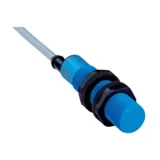
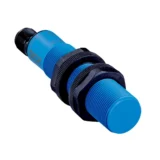
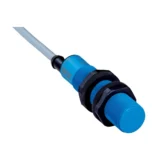
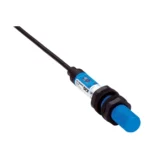
Description
SICK CM30-16BAP-KW1 AC Two-Wire Capacitive Sensor
Technical Overview
The SICK CM30-16BAP-KW1 is a flush-mount capacitive proximity sensor with an M30 × 1.5 threaded housing and AC two-wire NC or NO operation. It detects nearby material through changes in capacitance, supporting qualified metal and nonmetal targets. Its specified sensing range is 2–16 mm, with actual reach dependent on material and installation. The 11-turn sensitivity potentiometer adapts detection sensitivity. The sensor operates from 20–250 V AC at 10 Hz and connects through a 2 m two-wire PVC cable. Its PBT plastic provides IP67 protection according to EN 60529, and two mounting nuts plus a screwdriver are supplied. Material reduction factors guide application setup.
M30 × 1.5 flush capacitive sensor with AC two-wire NC or NO operation, 2–16 mm specified sensing range, 11-turn sensitivity potentiometer and 2 m two-wire PVC cable.
Key Features
- Capacitive proximity detection of qualified metal and nonmetal materials
- M30 × 1.5 threaded housing for flush installation
- 2–16 mm specified range; material-dependent detection distance
- Ac two-wire nc or no operation
- 11-turn sensitivity potentiometer
- 20–250 V AC supply; 10 Hz switching
- 2 m two-wire pvc cable
- IP67 according to EN 60529; PBT plastic
- Two mounting nuts and one potentiometer screwdriver included
Technical Specification Matrix
| Parameter | Value |
|---|---|
| Functional principle | Capacitive proximity sensing |
| Housing design | Metric threaded housing |
| Thread size | M30 × 1.5 |
| Housing diameter | 30 mm |
| Sensing range | 2–16 mm |
| Assured sensing distance | 11.52 mm |
| Installation | Flush |
| Switching frequency | 10 Hz |
| Electrical wiring | AC, 2-wire |
| Switching output | Ac two-wire nc or no |
| Output function | NC or NO |
| Adjustment | 11-turn sensitivity potentiometer |
| Material reduction factors | Reference values, material dependent: metal 1; water 1; PVC approximately 0.4; oil approximately 0.25; glass 0.6; ceramics 0.5; alcohol 0.7; wood 0.2–0.7 |
| Power supply | 20–250 V AC |
| Residual ripple | ≤10% of supply voltage |
| Current consumption | 10 mA without load |
| Initialization time | ≤100 ms |
| Hysteresis | 4–20% of sensing range |
| Reproducibility | ≤5% of sensing range at constant supply voltage and ambient temperature |
| Temperature drift | ±10% of sensing range |
| EMC | EN 60947-5-2; conducted interference in the oscillator frequency range may change the output signal; observe manufacturer operating instructions |
| Output current | ≤500 mA |
| Connection | 2 m two-wire pvc cable |
| Cable material | PVC; do not bend below 0 °C |
| Conductor cross-section | 0.5 mm² |
| Power-up pulse suppression | Yes |
| Shock resistance | 30 g for 11 ms |
| Vibration resistance | 10–55 Hz at 1 mm amplitude |
| Operating temperature | −25 to +80 °C |
| Housing material | PBT plastic |
| Housing length | 63.6 mm |
| Thread length | 50 mm |
| Maximum tightening torque | ≤7.5 Nm |
| IP rating | IP67 according to EN 60529 |
| Items supplied | Two PA12 plastic mounting nuts and one potentiometer screwdriver |
| Indicator | Display LED |
| MTTFD | 815 years |
| Diagnostic coverage DCavg | 0% |
| Mission time | 20 years |
| Wire assignment | BN: L1; BU: N; AC two-wire load connection as shown in manufacturer CD-013 |
Industrial Applications
1. Checking a nonmetal part in an assembly fixture
An assembly fixture can place a qualified nonmetal part near the sensing face and use the AC two-wire NC or NO signal to confirm its local presence. The 11-turn sensitivity potentiometer adapts sensitivity to the actual target and surrounding fixture. Commissioning compares empty and occupied states at the installed spacing, taking the documented material reduction factors into account.
A local presence signal helps the controller detect a missing part before the next assembly step, without requiring a metal target on the component or a contact actuator.
2. Detecting a liquid at a point in a nonmetal vessel
A suitable nonmetal vessel can position the sensor outside its wall at the desired detection point. After testing the actual wall, liquid and spacing, the 11-turn sensitivity potentiometer sets a threshold between empty and filled conditions. The AC two-wire NC or NO output provides a discrete point-level event to a compatible controller; the specified range remains subject to the installed materials.
A qualified external point-level signal helps the process controller identify liquid reaching the monitored height while avoiding a probe inside the vessel and preserving the vessel wall.
3. Monitoring granulate at a feed inspection window
A granulate feeder can place the sensor beside a suitable nonmetal inspection window to check whether material occupies the monitored location. The 11-turn sensitivity potentiometer is set using the actual granulate, window and installation spacing. Empty and filled tests, including expected moisture and buildup conditions, qualify the discrete output before it is used to coordinate feeding.
A local material-presence event helps the controller identify an empty feed location or arrival of replenishment material, supporting feed sequencing without placing a mechanical paddle in the granulate.