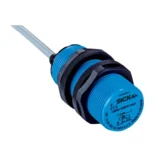
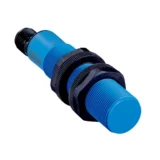
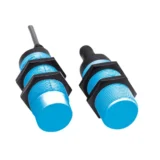
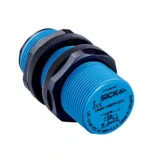
Description
SICK CM12-08EBP-KW1 Teach-In Capacitive Sensor
Technical Overview
The SICK CM12-08EBP-KW1 is a capacitive proximity sensor with an M12 × 1 threaded housing and PNP/NPN with NC or NO function output. It detects nearby material by evaluating changes in capacitance, supporting qualified metal and nonmetal targets. Its specified range is 0.5–8 mm non-flush or 0.5–4 mm flush, with actual reach dependent on material and installation. The local button and external wire teach-in adapts sensitivity to the target and surroundings. The sensor operates from 10–36 V DC at 15 Hz and connects through a 2 m four-wire PVC cable. Its plastic housing provides IP68 protection, and two PA12 mounting nuts are included. Material reduction factors guide commissioning.
M12 × 1 capacitive sensor with PNP/NPN with NC or NO function output, 0.5–8 mm non-flush or 0.5–4 mm flush range, local button and external wire teach-in, 15 Hz switching and 2 m four-wire PVC cable.
Key Features
- Capacitive proximity sensing for qualified metal and nonmetal targets
- M12 × 1 threaded housing
- 0.5–8 mm non-flush or 0.5–4 mm flush specified sensing range
- Pnp/npn with nc or no function output
- Local button and external wire teach-in
- 10–36 V DC operating supply; 15 Hz switching
- 2 m four-wire PVC cable
- IP68 protection; IP68 test: 1.3 m water depth for 60 min
- Material-dependent range; manufacturer reference reduction factors available
- Two PA12 plastic mounting nuts included
Technical Specification Matrix
| Parameter | Value |
|---|---|
| Functional principle | Capacitive proximity sensing |
| Housing design | Metric threaded housing |
| Thread size | M12 × 1 |
| Housing diameter | 12 mm |
| Sensing range | 0.5–8 mm non-flush or 0.5–4 mm flush |
| Assured sensing distance | 5.76 mm |
| Installation | Non-flush or flush; flush installation requires teach-in |
| Switching output | Pnp/npn with nc or no function |
| Output function | NC or NO |
| Output characteristic | Wire configurable; automatic detection |
| Electrical wiring | DC, 4-wire |
| Adjustment | Local button and external wire teach-in |
| Switching frequency | 15 Hz |
| Material reduction factors | Reference values, material dependent: metal 1; water 1; PVC approximately 0.4; oil approximately 0.25; glass 0.6; ceramics 0.5; alcohol 0.7; wood 0.2–0.7 |
| Power supply | 10–36 V DC |
| Residual ripple | ≤10% of supply voltage |
| Voltage drop | ≤2.5 V DC at maximum output current |
| Current consumption | 12 mA without load |
| Initialization time | ≤120 ms |
| Hysteresis | 3–20% of sensing range |
| Reproducibility | ≤5% of sensing range at constant supply voltage and ambient temperature |
| Output current | ≤200 mA |
| Short-circuit protection | Yes |
| Power-up pulse suppression | Yes |
| Connection | 2 m four-wire PVC cable |
| Housing material | Plastic |
| IP rating | IP68 |
| IP68 test condition | 1.3 m water depth for 60 min |
| Operating temperature | −20 to +85 °C |
| Storage temperature | −40 to +85 °C |
| Maximum tightening torque | ≤1 Nm |
| Items supplied | Two PA12 plastic mounting nuts |
| MTTFD | 603 years |
| Diagnostic coverage DCavg | 0% |
| Mission time | 20 years |
| UL file | NRKH.E191603 |
| Wire assignment | BN: L+; BK: NO/NC; WH: Teach; BU: M |
| Indicators | Yellow: output active; green: power and signal reserve |
| EMC | EN 60947-5-2; datasheet requires sensor grounding and minimum 1 × Sn for non-flush installation |
| Shock resistance | 30 g for 11 ms |
| Vibration resistance | 10–55 Hz at 1 mm amplitude |
| Cable material | PVC; do not bend below 0 °C |
| Conductor cross-section | 0.14 mm² |
Industrial Applications
1. Checking a nonmetal part in an assembly fixture
An assembly fixture can place a qualified nonmetal part near the sensing face and use the PNP/NPN with NC or NO function signal to confirm its local presence. The local button and external wire teach-in adapts sensitivity to the actual target and surrounding fixture. Commissioning compares empty and occupied states at the installed spacing, taking the documented material reduction factors into account.
A local presence signal helps the controller detect a missing part before the next assembly step, without requiring a metal target on the component or a contact actuator.
2. Detecting a liquid at a point in a nonmetal vessel
A suitable nonmetal vessel can position the sensor outside its wall at the desired detection point. After testing the actual wall, liquid and spacing, the local button and external wire teach-in sets a threshold between empty and filled conditions. The PNP/NPN with NC or NO function output provides a discrete point-level event to a compatible controller; the specified range remains subject to the installed materials.
A qualified external point-level signal helps the process controller identify liquid reaching the monitored height while avoiding a probe inside the vessel and preserving the vessel wall.
3. Monitoring granulate at a feed inspection window
A granulate feeder can place the sensor beside a suitable nonmetal inspection window to check whether material occupies the monitored location. The local button and external wire teach-in is set using the actual granulate, window and installation spacing. Empty and filled tests, including expected moisture and buildup conditions, qualify the discrete output before it is used to coordinate feeding.
A local material-presence event helps the controller identify an empty feed location or arrival of replenishment material, supporting feed sequencing without placing a mechanical paddle in the granulate.