Description
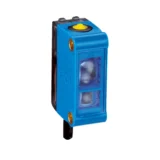
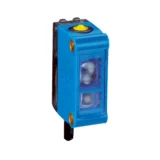
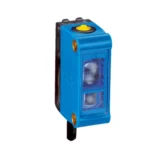
SICK CSM-WN111C2P NPN One-color Sensor
Technical Overview
The SICK CSM-WN111C2P is a compact color sensor with RGB LEDs and one NPN color-output channel. It emits light from the long side of its housing, producing a vertical 1.9 × 9.4 mm spot. Sensing distance is specified as no more than 12.5 mm, with a ±3 mm distance tolerance. The button supports static and dynamic teaching, while the ET input supports dynamic teaching. Response time is 300 µs, jitter is 150 µs and switching frequency is 1.7 kHz at a 1:1 light/dark ratio. The sensor uses 12–24 V DC, an ABS housing, PMMA optics and IP67 protection. A 0.2 m PVC cable terminates in an A-coded M12 four-pin male connector.
RGB LED color sensor with one NPN color channel, local static/dynamic teaching, dynamic external teaching and 0.2 m M12 four-pin connection cable.
Key Features
- RGB LED color sensing with one NPN color-output channel
- 640 nm, 525 nm and 470 nm LED wavelengths
- Sensing distance ≤12.5 mm; distance tolerance ±3 mm
- Vertical 1.9 ×9.4 mm light spot; emission from long housing side
- Teach-in button: static/dynamic; ET input: dynamic
- 300 µs response; 150 µs jitter; 1.7 kHz at 1:1 light/dark ratio
- 12–24 V DC nominal; consumption <50 mA without load
- Output current <100 mA; maximum 50 mA above 24 V supply
- 0.2 m PVC cable with A-coded M12 four-pin male connector
- IP67; ABS housing; PMMA optics; −10 to +55 °C operation
Technical Specification Matrix
| Parameter | Value |
|---|---|
| Functional principle | RGB LED color sensing |
| Output channels | One color |
| Light emission | Long side of housing |
| Light source | RGB LEDs; average service life 100,000 h at ambient +25 °C |
| Wavelengths | 640 nm; 525 nm; 470 nm |
| Sensing distance | ≤12.5 mm |
| Sensing-distance tolerance | ±3 mm |
| Light spot size | 1.9 ×9.4 mm |
| Light spot direction | Vertical |
| Adjustment | Teach-in button |
| Teach-in modes | Button: static/dynamic; external ET: dynamic |
| Switching output | NPN |
| Output voltage | HIGH approximately supply voltage; LOW ≤2 V |
| Output current | <100 mA; at supply voltage >24 V, maximum total output current 50 mA |
| External teach input | NPN: Teach U<2 V; Run U=10 V to below supply voltage, or open |
| Response time | 300 µs |
| Jitter | 150 µs |
| Switching frequency | 1.7 kHz at 1:1 light/dark ratio |
| Time delay | None |
| Power supply | 12–24 V DC nominal; limits 12 V −10% to 24 V +20%; short-circuit-protected network maximum 8 A |
| Ripple | <5 Vpp; remain within supply tolerances |
| Current consumption | <50 mA without load |
| Protection class | III |
| Electrical protection | Supply reverse-polarity protection; output Q short-circuit protection; interference-pulse suppression |
| Connection | 0.2 m PVC cable with A-coded M12 four-pin male connector |
| Cable diameter | Ø3.4 mm |
| Conductor cross-section | 0.15 mm² |
| Pin assignment | 1 BN=L+; 2 WH=ET; 3 BU=M; 4 BK=Q |
| Housing material | ABS |
| Optics material | PMMA |
| IP rating | IP67 |
| Operating temperature | −10 to +55 °C |
| Storage temperature | −20 to +75 °C |
| Shock load | According to IEC 60068 |
| Mounting | M3 mounting holes |
| Indicators | Yellow and green LEDs |
| UL files | NRKH.E348498 and NRKH7.E348498 |
Industrial Applications
1. Checking a colored insert in an assembly nest
An assembly nest can present an insert’s colored surface at a repeatable close working distance. Local static teaching establishes the target-color condition and external inspection logic samples the single NPN channel after the insert settles. Commissioning checks representative color variations, surface orientation and placement against the specified sensing distance, tolerance and vertical spot coverage.
A taught-color comparison helps external inspection logic identify a mismatched or missing colored insert at the checked location, using a repeatable optical presentation before assembly continues.
2. Sorting a selected color from mixed components
A parts guide can carry mixed colored components through a fixed sensing point and present the selected color to the sensor. Dynamic teaching establishes the comparison condition for the actual feed. External sorting logic evaluates the single NPN signal and coordinates a downstream diverter, with part gaps and transit timing checked against response, jitter and switching-frequency specifications.
A single selected-color signal gives external sorting logic a criterion for separating one color from other presented components, using commissioned teaching and synchronized downstream handling.
3. Triggering a process step from a colored marker
A material feed can present a repeating colored marker beneath the vertical light spot at a controlled close distance. The sensor’s taught-color channel supplies a transition to external sequencing electronics, which times the associated process step. Setup verifies actual marker and background colors, optical coverage, feed motion and trigger consistency against the documented response and jitter.
A detected colored marker supplies an optical timing reference to external sequencing electronics, helping align a process action with the marker position on the moving material.