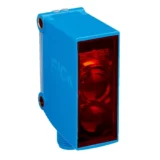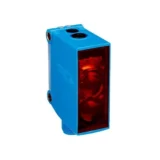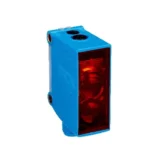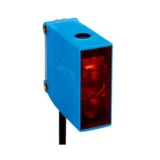
Description
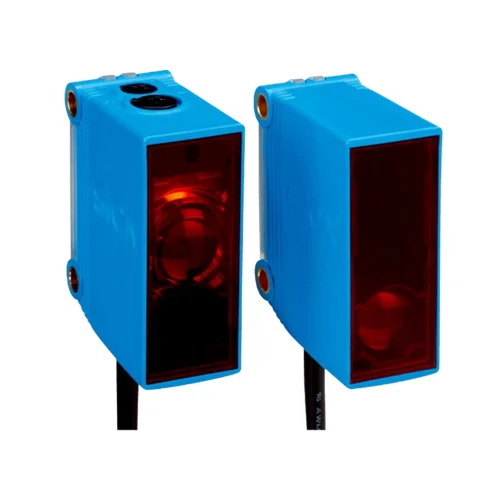
SICK GSE10-N1211 NPN Through-beam Sensor Pair
Technical Overview
The SICK GSE10-N1211 is a through-beam photoelectric sensor pair using a 625 nm red PinPoint LED and separate sender and receiver. Sensing range is 0–35 m, with 0–40 m maximum range stated separately and a 180 mm spot at 15 m. A 270° potentiometer adjusts sensing range, while a separate selector establishes light or dark switching for the single NPN output. Response is no more than 500 µs with resistive load, with 1,000 Hz operation at a 1:1 ratio. Both heads connect through 2 m three-wire PVC cables. The rectangular ABS/PMMA housings provide IP67 protection, mounting holes and received-light/power indication; a 0 V test command switches the sender off.
Red PinPoint through-beam pair with 0–35 m sensing, single NPN output, 270° adjustment, separate light/dark selector and 2 m PVC cables.
Key Features
- Separate sender and receiver; 0–35 m sensing, 0–40 m maximum
- 625 nm red PinPoint LED; Ø180 mm spot at 15 m
- 270° sensing-range potentiometer and separate light/dark selector
- Single NPN output; maximum current ≤100 mA
- Response ≤500 µs with resistive load; 1,000 Hz at 1:1 light/dark ratio
- Sender-off test at Test=0 V
- 2 m three-wire PVC cables; conductor cross-section 0.14 mm²
- 10–30 V DC; sender ≤15 mA and receiver ≤20 mA
- ABS/PMMA housings; IP67; −30 to +60 °C operation
- Supply and input/output reverse-polarity protection, interference suppression and output short-circuit protection
Technical Specification Matrix
| Parameter | Value |
|---|---|
| Functional principle | Through-beam photoelectric sensor pair |
| Sensing range | 0–35 m |
| Maximum sensing range | 0–40 m |
| Light source | Visible red PinPoint LED; 625 nm |
| Average LED service life | 100,000 h at +25 °C |
| Light spot size | Ø180 mm at 15 m |
| Additional spot sizes | Ø15 mm at 0.1 m; Ø435 mm at 35 m; Ø501 mm at 40 m |
| Adjustment | Sensing-range potentiometer, 270° |
| Switching output | Single NPN |
| Switching mode | Light/dark switching; separate light/dark selector |
| Output current | ≤100 mA |
| Response time | ≤500 µs signal transit time with resistive load |
| Switching frequency | 1,000 Hz at 1:1 light/dark ratio |
| Power supply | 10–30 V DC; short-circuit-protected network, maximum 8 A |
| Ripple | <5 Vpp; remain within supply tolerances |
| Sender current consumption | ≤15 mA |
| Receiver current consumption | ≤20 mA |
| Circuit protection | Supply and input/output reverse-polarity protection; interference suppression; output overcurrent and short-circuit protection |
| Protection class | III |
| Connection | 2 m three-wire PVC cables; do not bend below 0 °C |
| Conductor cross-section | 0.14 mm² |
| Sender conductor functions | CD-061: BN=L+; BU=M; BK=Test |
| Receiver conductor functions | CD-061: BN=L+; BU=M; BK=Q |
| Test function | Sender OFF at Test=0 V |
| Housing design | Rectangular |
| Housing material | ABS/PMMA plastic |
| Mounting | Ø4.2 mm holes; 36 mm center spacing |
| Indication | Yellow: received-light-beam state; green: power on |
| IP rating | IP67 |
| Operating temperature | −30 to +60 °C |
| Storage temperature | −40 to +70 °C |
| EMC | EN 60947-5-2 |
| UL file | NRKH.E348498 and NRKH7.E348498 |
| UL325 condition | Complies when used with a sturdy protection hood, e.g. BEF-G10WSG 2071960 |
Industrial Applications
1. Counting separated opaque loads across a conveyor
A conveyor can position the sender and receiver on opposite sides of separated opaque loads and feed NPN transitions into an external counter. The direct optical path avoids dependence on light reflected by the load surface. Commissioning relates target coverage and spacing to the response of no more than 500 µs, the 1,000 Hz rating and the installed sensing distance.
Direct-beam interruptions provide passage events for external counting electronics, helping track separated opaque loads across a conveyor using an opposed sender and receiver.
2. Monitoring an opaque sheet feed for loss of continuity
A sheet feeder can place the direct beam across a location normally occupied by opaque material. A break or exhausted feed clears the path and changes the NPN state. External logic times this condition to distinguish sustained material loss from intentional gaps, while the light/dark selector establishes the expected electrical logic and local indicators assist alignment.
A sustained clear-path event gives external feeder monitoring a continuity reference, helping identify missing material before the next process runs without its intended sheet.
3. Checking the optical signal chain during a machine test
An external diagnostic routine can pull the sender Test conductor to 0 V and observe the receiver’s NPN output. Switching the sender off creates a commanded optical interruption without moving a test load. The routine compares the resulting receiver state with its expected sequence, using the selected light/dark logic and documented response as the timing basis.
A commanded sender-off event gives external diagnostics a controlled response observation, helping check the optical and electrical signal chain without requiring a physical load passage.