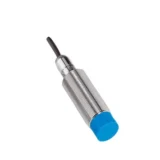
Description
SICK IME12-02BPSZC0S PNP Flush Inductive Proximity Sensor
Technical Overview
The SICK IME12-02BPSZC0S is a standard-design M12 × 1 inductive proximity sensor for flush installation. Nominal sensing range is 2 mm and assured sensing range is 1.62 mm, with material-dependent reduction factors for nonferrous and stainless targets. Its PNP normally-open output switches at up to 2,000 Hz and supports continuous current up to 200 mA. The 10–30 V DC three-wire device connects through an M12 four-pin male connector. A nickel-plated brass housing and PA66 sensing face provide IP67 protection. Two nickel-plated brass mounting nuts are supplied. Operating temperature spans −30 to +75 °C, and maximum tightening torque is 12 Nm.
Flush standard-design M12 inductive sensor with 2 mm nominal range, 1.62 mm assured range, PNP normally-open output and an M12 four-pin male connector.
Key Features
- Inductive proximity sensing; standard-design M12 × 1 housing; flush installation
- 2 mm nominal sensing range; 1.62 mm assured sensing range
- PNP normally-open output; DC three-wire configuration
- 2,000 Hz switching frequency; continuous output current ≤200 mA
- 10–30 V DC; no-load current ≤10 mA; voltage drop ≤2 V at maximum load
- ≤100 ms time delay before availability; short-circuit and power-up pulse protection
- M12 four-pin male connector
- Nickel-plated brass housing; PA66 sensing face; IP67
- Two nickel-plated brass mounting nuts supplied; 17 mm across flats
- −30 to +75 °C operation; tightening torque ≤12 Nm
Technical Specification Matrix
| Parameter | Value |
|---|---|
| Functional principle | Inductive proximity sensor |
| Housing design | Metric standard-design |
| Mounting thread | M12 × 1 |
| Installation | Flush |
| Nominal sensing range Sn | 2 mm |
| Assured sensing range Sa | 1.62 mm |
| Switching output | PNP |
| Output function | Normally open (NO) |
| Electrical wiring | DC three-wire |
| Switching frequency | 2,000 Hz |
| Power supply | 10–30 V DC |
| Ripple | ≤10% |
| Voltage drop | ≤2 V at maximum output current |
| Time delay before availability | ≤100 ms |
| Hysteresis | 5–15% |
| Reproducibility | ≤2% of real sensing range Sr at constant supply voltage and ambient temperature |
| Temperature drift | ±10% of real sensing range Sr |
| Continuous output current | ≤200 mA |
| No-load current | ≤10 mA |
| Short-circuit protection | Provided |
| Power-up pulse protection | Provided |
| Connection | M12 four-pin male connector |
| Wire assignments | CD-007: 1 BN=L+; 4 BK=normally-open output; 2=not connected; 3 BU=M |
| Housing material | Nickel-plated brass |
| Sensing face material | PA66 plastic |
| Housing length | 65 mm |
| Thread length | 48 mm |
| Tightening torque | ≤12 Nm |
| IP rating | IP67 according to EN 60529 |
| Items supplied | Two nickel-plated brass mounting nuts; 17 mm across flats |
| Indicator | Display LED |
| Operating temperature | −30 to +75 °C |
| Shock resistance | 30 g, 11 ms |
| Vibration resistance | 10–55 Hz, 1 mm amplitude |
| EMC | According to EN 60947-5-2 |
| UL file | NRKH.E181493 |
| MTTFD | 1,735 years |
| DCavg | 0% |
| Material reduction factors | Reference values, may vary: St37 steel 1; stainless steel V2A/304 approximately 0.8; aluminum approximately 0.45; copper approximately 0.4; brass approximately 0.4 |
| Special characteristic | Extended operating temperature |
Industrial Applications
1. Confirming a metal clamp at its seated position
A fixture can present a metal clamp target to the flush sensing face at a controlled final gap. External sequencing logic samples the PNP normally-open output after the clamp settles. Commissioning checks target material, thickness and placement tolerance against the nominal and assured ranges, accounting for material reduction factors before accepting the seated condition.
A clamp-position reference helps external sequencing logic distinguish a seated metal target from an open location, using a flush inductive sensing point checked for the actual target material.
2. Counting separated metal flags on a moving mechanism
A moving mechanism can carry separated metal flags past the inductive sensing face and feed PNP transitions to external counting electronics. Setup checks flag material, coverage, passing gap and the separation between flags. Motion timing is verified against the 2,000 Hz switching frequency, and the connected input respects the continuous-current and voltage-drop limits.
A metal-flag passage reference helps external counting electronics register repeated mechanical events, using contactless inductive switching checked for the actual target spacing, material and travel speed.
3. Referencing a carriage near a travel position
A carriage can bring a metal reference tab toward the flush-mounted sensor near a defined travel position. External motion logic reads the PNP normally-open state as a position reference. Installation checks tab material, approach geometry and allowable gap, while commissioning accounts for reproducibility, hysteresis and temperature drift so the reference remains meaningful over the expected operating conditions.
A carriage-reference signal helps external motion logic identify a checked mechanical position, using inductive target detection and installation margins established for the actual approach geometry and temperature range.