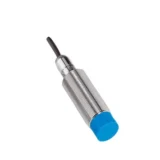
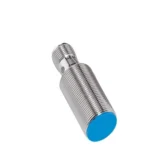
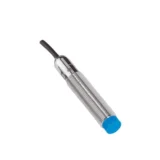
Description
SICK IME12-04BPSZW2S PNP Inductive Proximity Sensor
Technical Overview
The SICK IME12-04BPSZW2S is an M12 inductive proximity sensor with a PNP normally open output and DC three-wire connection. Its electromagnetic sensing principle detects metal targets without requiring optical access or a separate reflector. The nominal sensing range is 4 mm, with an assured sensing range of 3.24 mm; nonferrous targets require the documented material reduction factors. Flush installation and an M12 × 1 threaded nickel-plated brass housing support integration in a metal fixture. The sensor provides 2,000 Hz switching and operates from 10–30 V DC, with a 2 m three-wire PVC cable, PA66 sensing face and IP67 enclosure rating.
Flush M12 inductive sensor with 4 mm nominal range, PNP normally open output, 2,000 Hz switching and 2 m three-wire PVC cable.
Key Features
- Inductive proximity detection of metal targets
- 4 mm nominal sensing range; 3.24 mm assured range
- Flush installation; M12 × 1 threaded housing
- PNP normally open output; DC three-wire wiring
- 2,000 Hz switching frequency
- 10–30 V DC operation; ≤10 mA no-load current
- Continuous output current ≤200 mA
- Nickel-plated brass housing; PA66 sensing face
- IP67; −25 to +75 °C operating range
- 2 m three-wire pvc cable; two mounting nuts supplied
Technical Specification Matrix
| Parameter | Value |
|---|---|
| Functional principle | Inductive proximity sensing of metal targets |
| Housing form | Metric cylindrical, standard design |
| Thread size | M12 × 1 |
| Housing diameter | 12 mm |
| Nominal sensing range Sn | 4 mm |
| Assured sensing range Sa | 3.24 mm |
| Installation type | Flush |
| Switching frequency | 2,000 Hz |
| Switching output | PNP |
| Output function | Normally open (NO) |
| Electrical wiring | DC 3-wire |
| Connection | Cable, 3-wire, 2 m |
| Power supply | 10–30 V DC |
| Residual ripple | ≤10% |
| Voltage drop | ≤2 V at maximum output current |
| Time delay before availability | ≤100 ms |
| Hysteresis | 5–15% |
| Reproducibility | ≤2% of Sr at constant supply and ambient temperature |
| Temperature drift | ±10% of Sr |
| Continuous output current | ≤200 mA |
| No-load current | ≤10 mA |
| Housing material | Brass, nickel-plated |
| Sensing face material | PA66 plastic |
| Housing length | 63 mm |
| Thread length | 48 mm |
| Maximum tightening torque | ≤12 Nm |
| Items supplied | 2 nickel-plated brass mounting nuts |
| IP rating | IP67 according to EN 60529 |
| Operating temperature | −25 to +75 °C |
| EMC | EN 60947-5-2 |
| Shock and vibration resistance | 30 g, 11 ms / 10–55 Hz, 1 mm |
| Reference material reduction factors | St37 steel: 1; stainless steel V2A/304: approximately 0.8; aluminum: approximately 0.45; copper/brass: approximately 0.4; reference values may vary |
| MTTFD | 1,735 years |
| Diagnostic coverage DCavg | 0% |
| UL file | NRKH.E181493 |
| Cable jacket material | PVC |
| Conductor cross-section | 0.25 mm² |
| Cable diameter | Ø3.9 mm |
Industrial Applications
1. Confirming a metal part in a fixture
A machining fixture can place the sensor beside the expected location of a metal part so the target enters its assured sensing zone when seated. Flush installation allows mounting in the fixture face, and the PNP normally open output provides the presence signal. Target material must be considered using the documented reduction factors.
A contactless metal-presence signal helps the sequence controller identify an occupied fixture position before the next operation, avoiding a mechanical feeler pressing against the seated part.
2. Counting metal tabs on a rotating mechanism
A rotating mechanism can present separated metal tabs to the M12 sensing face and count each normally open output transition. The 2,000 Hz switching frequency supports repeated passages within the documented limits. Tab geometry, spacing, operating gap and material reduction factors must be qualified so consecutive targets produce distinct switching events.
Discrete tab passages provide the controller with a pulse count related to mechanism rotation, supporting cycle counting without an optical beam or contacting follower on the moving tabs.
3. Confirming a shuttle at a transfer position
A shuttle can carry a metal flag that enters the sensor’s local detection zone at a transfer position. The M12 thread and two supplied mounting nuts support fixed installation, while the normally open PNP signal reports the flag state. IP67 protection and the nickel-plated brass body support exposed machine placement.
A local position-confirmation signal helps the controller coordinate transfer sequencing when the metal flag reaches the monitored point, without a mechanical switch actuator following each shuttle movement.