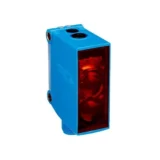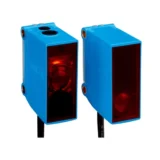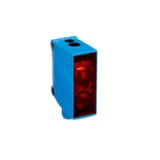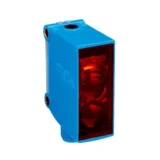
Description
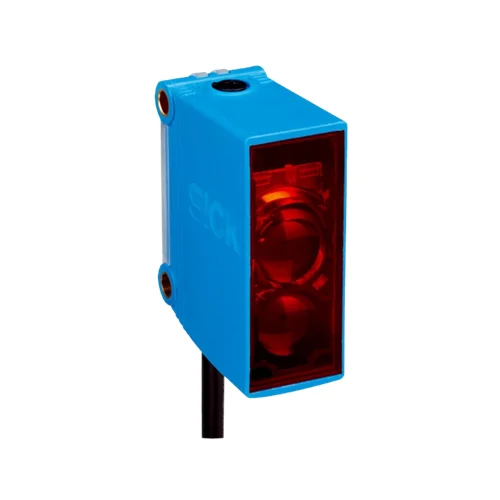
SICK GL10-P7151 PNP Retro-Reflective Sensor
Technical Overview
The SICK GL10-P7151 is a polarized dual-lens retro-reflective photoelectric sensor with a documented application for film-wrapped objects. With a PL80A reflector, sensing range is 0.3–9.5 m and maximum range is 0.15–12 m; P250 provides different stated limits. Its 625 nm red PinPoint LED forms a 58 mm spot at 5 m. Sensitivity has no adjustment, while a local selector chooses light or dark operation for the single PNP output. Response is no greater than 1 ms under resistive load, with 500 Hz switching at a 1:1 ratio. The IP67 ABS/PMMA housing operates on 10–30 V DC and connects through a 300 mm PVC lead with an M12 four-pin male connector.
Polarized dual-lens retro-reflective sensor for film-wrapped objects, with single PNP light/dark output and a 300 mm PVC lead to M12 four-pin plug.
Key Features
- Polarized dual-lens retro-reflective sensing; minimum reflector distance applies
- Manufacturer application: detecting objects wrapped in film
- PL80A sensing 0.3–9.5 m; maximum 0.15–12 m
- P250 sensing 0.3–8 m; maximum 0.15–10 m
- 625 nm red PinPoint LED; Ø58 mm light spot at 5 m
- No sensitivity adjustment; separate light/dark selector
- Single PNP output; response ≤1 ms with resistive load; 500 Hz at 1:1 ratio
- 300 mm PVC cable with M12 four-pin male connector
- 10–30 V DC; 20 mA consumption; output current ≤100 mA
- ABS/PMMA housing; IP67; −30 to +60 °C operation
Technical Specification Matrix
| Parameter | Value |
|---|---|
| Functional principle | Photoelectric retro-reflective sensor with dual-lens optics |
| Reflector condition | Minimum distance to reflector applies |
| Sensing range, PL80A | 0.3–9.5 m |
| Maximum range, PL80A | 0.15–12 m |
| Sensing range, P250 | 0.3–8 m |
| Maximum range, P250 | 0.15–10 m |
| Light source | Visible red PinPoint LED; 625 nm |
| Average LED service life | 100,000 h at +25 °C |
| Light spot size | Ø58 mm at 5 m |
| Polarizing filter | Yes |
| Adjustment | No sensitivity adjustment |
| Manufacturer application | Detecting objects wrapped in film; high functional reliability on foil-wrapped objects |
| Switching output | Single PNP |
| Switching mode | Light/dark switching selected by local selector |
| Output current | ≤100 mA |
| Response time | ≤1 ms signal transit time with resistive load |
| Switching frequency | 500 Hz at 1:1 light/dark ratio |
| Power supply | 10–30 V DC; short-circuit-protected network, maximum 8 A |
| Ripple | <5 Vpp; remain within supply-voltage tolerances |
| Current consumption | 20 mA |
| Connection | 300 mm PVC cable with M12 four-pin male connector; do not bend below 0 °C |
| Pin assignment | CD-066: 1 BN=L+; 2 WH=not connected; 3 BU=M; 4 BK=Q |
| Circuit protection | Supply and input/output reverse-polarity protection; interference suppression; output overcurrent and short-circuit protection |
| Protection class | III |
| Housing design | Rectangular |
| Housing material | ABS/PMMA plastic |
| Mounting holes | Ø4.2 mm |
| Indication | Yellow: received-light status; green: power on |
| IP rating | IP67 |
| Operating temperature | −30 to +60 °C |
| Storage temperature | −40 to +70 °C |
| EMC | EN 60947-5-2 |
| UL file | NRKH.E348498 and NRKH7.E348498 |
| UL325 condition | Manufacturer states compliance when used with a sturdy protection hood, for example BEF-G10WSG (2071960) |
| MTTFD | 2,063 years |
| DCavg | 0% |
| Other reflector ranges | Sensing / maximum: REF-IRF-56 tape 0.5–2.5 / 0.25–3.25 m; PL20A 0.3–4.5 / 0.15–6 m; PL30A 0.3–7 / 0.15–8.75 m; PL40A 0.3–9 / 0.15–11 m |
| Physical Weight (kg) | 0.035 |
Industrial Applications
1. Counting separated film-wrapped packages
A packaging conveyor can mount the sensor opposite a suitable reflector and pass separated film-wrapped loads through the optical path. The manufacturer specifically lists film-wrapped object detection, with a polarizing filter and fixed-sensitivity retro-reflective design. External counting logic reads PNP transitions, while commissioning verifies the actual wrapping, load coverage, reflector separation and timing against the 500 Hz rating.
The documented film-wrapped object capability provides an optical basis for package-passage events, helping external counting logic track separated wrapped loads at a selected conveyor point.
2. Recognizing accumulation at a wrapped-load transfer
A transfer station can place the reflector path across the downstream receiving location so a wrapped load blocks it while that point remains occupied. External logic compares the duration of the PNP condition with the normal transfer interval. The local light/dark selector supplies the required logic sense, and commissioning checks the actual wrap response and the selected reflector operating range.
A timed occupancy condition gives external transfer control a reference for sustained blockage, helping coordinate upstream load release when the downstream receiving position remains filled.
3. Monitoring continuity of an opaque material sheet
A sheet-handling machine can place the returned-light path across a normally occupied opaque material feed. A break or exhausted feed clears the path and changes the PNP output. External logic distinguishes persistent material loss from intentional gaps, while the installation respects the reflector minimum distance and operating range and uses the received-light indicator to establish alignment.
A persistent optical state change supplies external feed monitoring with a continuity reference, helping identify missing sheet material before later processing continues without the intended feed.