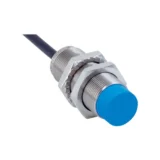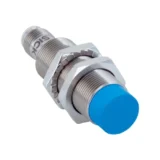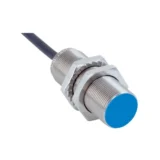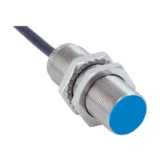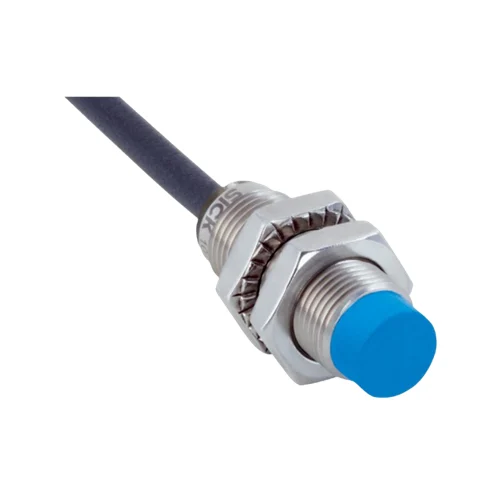
Description
SICK IMB12-08NNSVU2K M12 NPN NO Inductive Sensor
Technical Overview
The SICK IMB12-08NNSVU2K is a short-body M12 × 1 inductive proximity sensor for non-flush installation. Its 8 mm nominal and 6.48 mm assured sensing ranges are combined with an NPN normally-open output and 2,000 Hz switching. A 2 m three-wire PUR cable with 0.34 mm² conductors connects the 10–30 V DC device. The V2A stainless steel housing and LCP sensing face provide IP68/IP69K protection, coolant-lubricant resistance and operation from −40 to +100 °C. A visual adjustment indicator assists target positioning. The 34 mm housing has a 25 mm thread, and two toothed V2A mounting nuts are supplied; tightening torque depends on the nut side used.
Non-flush short M12 inductive sensor with 8 mm nominal range, NPN normally-open output, visual adjustment aid and a 2 m PUR cable.
Key Features
- Short-body M12 × 1 sensor for non-flush installation
- 8 mm nominal sensing range; 6.48 mm assured range
- NPN normally-open output; DC three-wire circuit; 2,000 Hz switching
- 2 m three-wire PUR cable; 0.34 mm² conductors
- 10–30 V DC; ≤200 mA output current; ≤10 mA no-load current
- Short-circuit protection and power-up pulse protection
- Visual adjustment indicator; coolant-lubricant resistance
- V2A stainless steel housing, DIN 1.4305/AISI 303; LCP sensing face
- IP68/IP69K; operation from −40 to +100 °C
- 34 mm housing, 25 mm thread and two toothed V2A nuts, 17 mm across flats
Technical Specification Matrix
| Parameter | Value |
|---|---|
| Functional principle | Inductive proximity sensor |
| Housing design | Short-body, metric |
| Mounting thread | M12 × 1; Ø12 mm |
| Installation | Non-flush |
| Nominal sensing range Sn | 8 mm |
| Assured sensing range Sa | 6.48 mm |
| Switching frequency | 2,000 Hz |
| Switching output | NPN; normally open |
| Electrical circuit | DC three-wire |
| Connection | 2 m three-wire PUR cable |
| Conductor cross-section | 0.34 mm² |
| Power supply | 10–30 V DC |
| Ripple | ≤10% |
| Voltage drop | ≤2 V at maximum continuous output current |
| Hysteresis | 3–20% |
| Reproducibility | ≤2% of Sr with constant supply voltage and ambient temperature |
| Temperature drift | ±10% of Sr |
| EMC | EN 60947-5-2 |
| Continuous output current | ≤200 mA |
| No-load current | ≤10 mA |
| Circuit protection | Short-circuit protection; power-up pulse protection |
| Special features | Coolant-lubricant resistance; visual adjustment indicator; temperature resistance |
| Shock and vibration resistance | 100 g / 2 ms / 500 cycles; 150 g / 1,000,000 cycles; 10–55 Hz / 1 mm; 55–500 Hz / 60 g |
| Operating temperature | −40 to +100 °C |
| Housing material | V2A stainless steel, DIN 1.4305 / AISI 303 |
| Sensing face material | LCP plastic |
| Housing length | 34 mm |
| Thread length | 25 mm |
| Tightening torque | Typical 20 Nm with non-toothed nut side; typical 32 Nm with toothed nut side |
| Items supplied | Two V2A stainless steel mounting nuts with locking teeth; 17 mm across flats |
| IP rating | IP68 to EN 60529; IP69K to ISO 20653:2013-03 |
| Protection class | III |
| UL file | E181493 |
| MTTFD | 1,971 years |
| DCavg | 0% |
| Material reduction factors | Reference values, may vary: St37 steel 1; stainless steel V2A/304 approximately 0.67; aluminum approximately 0.42; copper approximately 0.35; brass approximately 0.42 |
| Installation spacing | A=12 mm; B=24 mm; C=12 mm; D=24 mm; E=16 mm; F=64 mm; apply manufacturer non-flush diagram |
| Conductor functions | CD-452: BN=L+; BK=NO/C as manufacturer diagram; BU=M; selected product has NPN normally-open output |
Industrial Applications
1. Confirming a machining fixture clamp position
A machining fixture can bring a metal clamp target into the non-flush sensing zone after the clamp settles. Coolant-lubricant resistance and the stainless steel/LCP construction support placement near that process. External sequencing reads the NPN normally-open condition, while setup checks target material, installed gap and the required non-flush metal clearances.
A metal clamp-position reference helps external sequencing distinguish seated and withdrawn conditions at a fixture, using an inductive device designed for coolant and lubricant zones.
2. Counting metal carriers through a transfer point
Separated metal carriers can pass a fixed target area beside the sensor and supply NPN transitions to an external counter. The 2,000 Hz device rating establishes the sensor timing basis. Commissioning verifies actual carrier material, target size, speed and spacing so the sensor and receiving input resolve one distinct event for each carrier.
Distinct metal-target transitions give external counting logic a defined transfer event, helping track carrier quantities without requiring optical contrast on the passing surface.
3. Checking cyclic mechanism return timing
A cyclic mechanism can carry a metal return flag past the non-flush sensing face on each expected stroke. External monitoring compares the NPN event interval with the normal process timing and identifies a delayed or missing return. Setup establishes the sensing gap, uses the visual adjustment indicator and checks surrounding-metal clearances.
A recurring metal-position signal provides external monitoring with a return reference, helping distinguish the expected machine cycle from a late or interrupted movement.