Description
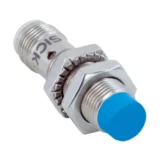
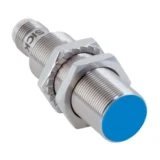
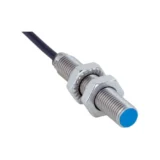
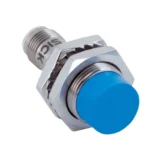
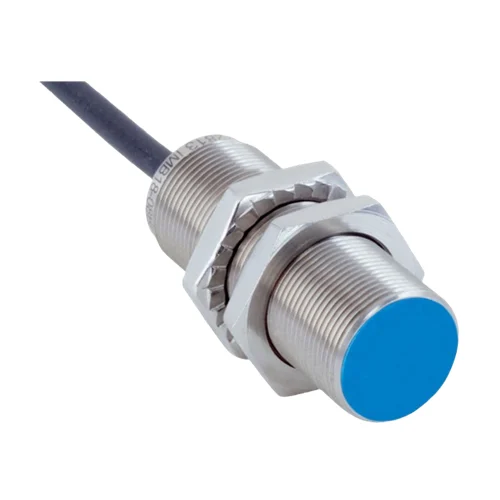
SICK IMB18-08BPSVU2S PNP IO-Link Inductive Sensor
Technical Overview
The SICK IMB18-08BPSVU2S is an M18 × 1 inductive proximity sensor with a PNP normally-open output and DC three-wire operation. Its nominal sensing range is 8 mm and assured range is 6.48 mm, with separate reduction factors for target metals. Quasi-flush installation requires 2 mm protrusion in conductive mounting material. IO-Link V1.0 reports Sr-reached and Sa-reached conditions in one byte of process data, while a visual adjustment indicator assists positioning. The 10–30 V DC device provides 1,000 Hz switching and connects through a 2 m three-wire PUR cable with 0.34 mm² conductors. Its V2A stainless steel housing and LCP sensing face provide IP68/IP69K protection, coolant-lubricant resistance and −40 to +100 °C operation.
M18 PNP normally-open inductive sensor with 8 mm nominal range, IO-Link V1.0, quasi-flush installation and a 2 m three-wire PUR cable.
Key Features
- M18 × 1 inductive proximity sensor; standard body
- 8 mm nominal range Sn; 6.48 mm assured range Sa
- Quasi-flush; protrusion E = 2 mm when mounted in conductive material
- PNP normally-open output; DC three-wire; 1,000 Hz switching
- 10–30 V DC; ≤200 mA continuous output; ≤10 mA no-load current
- 2 m three-wire PUR cable; 0.34 mm² conductors
- IO-Link V1.0, COM2, one-byte Sr/Sa process data
- V2A stainless steel, DIN 1.4305 / AISI 303 housing; LCP sensing face
- Coolant-lubricant resistance and visual adjustment indicator
- IP68 / IP69K; −40 to +100 °C operation
Technical Specification Matrix
| Parameter | Value |
|---|---|
| Functional principle | Inductive proximity sensing |
| Housing design | Metric M18 standard design |
| Mounting thread | M18 × 1 |
| Installation | Quasi-flush; protrusion E = 2 mm when mounted in conductive material |
| Nominal sensing range Sn | 8 mm |
| Assured sensing range Sa | 6.48 mm |
| Switching output | PNP normally open, NO |
| Electrical wiring | DC three-wire |
| Switching frequency | 1,000 Hz |
| Power supply | 10–30 V DC |
| Ripple | ≤10% |
| Voltage drop | ≤2 V at maximum output current |
| Continuous output current | ≤200 mA |
| No-load current | ≤10 mA |
| Hysteresis | 3–20% |
| Reproducibility | ≤2% of Sr at constant supply voltage and ambient temperature |
| Temperature drift | ±10% of Sr |
| Protection | Short-circuit and power-up pulse protection |
| Connection | 2 m three-wire PUR cable; 0.34 mm² conductors |
| Housing material | V2A stainless steel, DIN 1.4305 / AISI 303 |
| Sensing face material | LCP plastic |
| Tightening torque | Typical 60 Nm with non-toothed nut side; typical 90 Nm with toothed nut side |
| Items supplied | Two V2A stainless steel mounting nuts with locking teeth; 24 mm across flats |
| IP rating | IP68 to EN 60529; IP69K to ISO 20653:2013-03 |
| Operating temperature | −40 to +100 °C |
| EMC | EN 60947-5-2 |
| MTTFD | 1,971 years |
| DCavg | 0% |
| UL file | E181493 |
| Material reduction factors | Reference values may vary: St37 steel 1; V2A/304 stainless approximately .55; aluminum approximately .24; copper approximately .19; brass approximately .24 |
| Installation clearances | Manufacturer diagram labels A/B/C/D/E/F = 9 / 18 / 18 / 24 / 2 / 64 mm; E is protrusion in conductive mounting material |
| Special features | Resistance to coolant lubricants; visual adjustment indicator; temperature resistance |
| Manufacturer application areas | Zones with coolants and lubricants; mobile machines; difficult application conditions |
| Protection class | III |
| Shock resistance | 100 g / 2 ms / 500 cycles; 150 g / 1,000,000 cycles |
| Vibration resistance | 10–55 Hz / 1 mm; 55–500 Hz / 60 g |
| IO-Link | V1.0; COM2, 38.4 kBaud; one-byte process data |
| IO-Link process data | Bit 0 = Sr reached; bit 1 = Sa reached |
| Local adjustment aid | Visual LED indication relative to Sr and Sa positions, manufacturer installation-aid diagram |
| Housing length | 50 mm nominal body length |
| Conductor functions | CD-452: BN=L+; BK=NO/C; BU=M |
Industrial Applications
1. Confirming a metal fixture element is seated
An assembly fixture can present a metal locating element to the sensing face at a repeatable seated gap. The PNP normally-open output gives external sequence logic a discrete position condition after the mechanism settles. Commissioning uses the nominal and assured ranges, actual metal reduction factor and 2 mm conductive-mounting protrusion requirement.
A contactless metal-position reference helps external sequencing logic recognize a seated fixture element, supporting coordination of the following operation with the mechanism in its expected position.
2. Counting metal features passing a guide
A guide can move separated metal tabs past the fixed sensing face and route PNP transitions to an external counter. The 1,000 Hz switching rating provides the sensor timing basis. Setup checks actual tab material, target coverage, gap and separation against the documented sensing range and reduction factors so successive metal features produce distinct count events.
Metal-passage transitions give external counting logic discrete feature events, helping track feed movement without depending on optical surface color or an added magnetic target.
3. Observing detection margin through IO-Link
A fixture with a movable metal target can connect the sensor to an IO-Link master and read the separate Sr-reached and Sa-reached bits. External monitoring logic compares those two conditions over repeated presentations, while the local visual adjustment indicator assists setup. These discrete conditions provide a sensing-margin reference rather than a continuous distance measurement.
Separate Sr and Sa indications give external monitoring logic a basis for recognizing changes in target presentation margin, supporting maintenance observations without interpreting the process bits as numeric distance.