Description
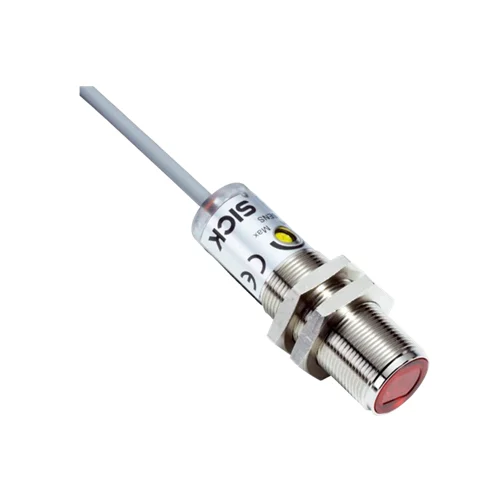
SICK VTE180-2N41142 M18 NPN Diffuse Photoelectric Sensor
Technical Overview
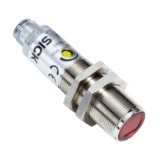
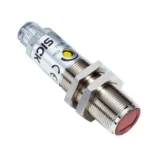
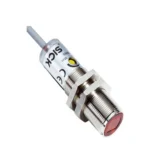
The SICK VTE180-2N41142 is an axial M18 energetic photoelectric proximity sensor with a visible red LED and one NPN output. It evaluates light returned from a target, with 1–350 mm sensing and 1–500 mm maximum range on 90% remission white under DIN 5033. A 270° potentiometer adjusts the sensing range, and the control wire selects light/dark switching, defaulting to light switching when open. Response is no more than 0.5 ms with resistive load, with 1,000 Hz switching at a 1:1 ratio. The 10–30 V DC sensor has a 2 m four-wire PVC cable, IP67 nickel-plated brass/PC housing and PMMA optics; two fastening nuts are supplied.
Axial M18 energetic red-light sensor with 1–350 mm reference-white sensing, NPN light/dark control, 1,000 Hz switching and a 2 m PVC cable.
Key Features
- Energetic photoelectric proximity sensing from one side
- 1–350 mm sensing and 1–500 mm maximum on 90% remission white, DIN 5033
- Axial optical axis; M18 ×1 threaded metal housing
- 645 nm visible red LED; Ø20 mm spot at 400 mm
- 270° sensing-range potentiometer
- One NPN output; light/dark selection through control wire; open wire = light switching
- ≤0.5 ms response with resistive load; 1,000 Hz at 1:1 light/dark ratio
- 10–30 V DC; ≤100 mA output; 30 mA consumption without load
- 2 m four-wire PVC cable; 0.18 mm² conductors; Ø3.8 mm cable
- IP67 nickel-plated brass/PC housing, PMMA optics and two fastening nuts
Technical Specification Matrix
| Parameter | Value |
|---|---|
| Functional principle | Energetic photoelectric proximity sensor |
| Sensing range | 1–350 mm on 90% remission reference white, DIN 5033 |
| Maximum sensing range | 1–500 mm on 90% remission reference white, DIN 5033 |
| Light source | Visible red LED; wavelength 645 nm |
| LED average service life | 100,000 hours at ambient temperature +25 °C |
| Light spot size | Ø20 mm at 400 mm |
| Focus / angle of dispersion | Approximately 1.5° |
| Adjustment | 270° sensing-range potentiometer |
| Housing design | Cylindrical metal design |
| Mounting thread | M18 ×1 |
| Optical axis | Axial |
| Housing length | 62.5 mm |
| Digital output | One NPN switching output; ≤100 mA |
| Switching mode | Light/dark switching via L/D control wire; control wire open = light switching L.ON |
| NPN signal voltage HIGH/LOW | Approximately supply voltage / <1.8 V |
| Response time | ≤0.5 ms with resistive load |
| Switching frequency | 1,000 Hz at light/dark ratio 1:1 |
| Power supply | 10–30 V DC; limit values in a short-circuit-protected network with maximum 8 A |
| Ripple | ±10%; supply tolerances must not be exceeded |
| Current consumption | 30 mA without load |
| Connection | 2 m four-wire PVC cable; do not bend below 0 °C |
| Conductor cross-section | 0.18 mm² |
| Cable diameter | 3.8 mm |
| Wire assignment | BN=brown L+; BU=blue M; BK=black Q; WH=white L/D (CD-089) |
| Circuit protection | A: supply reverse-polarity protection; B: inputs and output reverse-polarity protection; D: output overcurrent and short-circuit protection |
| Protection class | III |
| Housing material | Nickel-plated brass and PC |
| Optics material | PMMA plastic |
| IP rating | IP67 |
| Items supplied | Two fastening nuts |
| Fastening nuts | Metal; 24 mm across flats |
| Indicators | Orange: switching output; green: strength indicator |
| Operating temperature | −25 to +55 °C |
| Storage temperature | −40 to +70 °C |
| MTTFD | 1,899 years |
| DCavg | 0% |
| Physical Weight (kg) | 0.095 |
Industrial Applications
1. Counting separated opaque packages along a guide
A conveyor guide can keep successive opaque packages facing the sensor at a repeatable distance. Energetic optics evaluate returned red light, and the potentiometer establishes a detection condition using representative package surfaces and the actual background. External counting logic records NPN transitions after checking package spacing and transit timing against the response and switching limits.
Package passages become discrete events for external counting logic, allowing one-sided optical installation where a receiver or reflector cannot be mounted across the transport path.
2. Checking an insert in a stationary assembly nest
An assembly nest can present an insert at a controlled distance facing the axial optical axis. Sensitivity adjustment establishes reflected-light detection using representative loaded and empty nests, with actual surface remission and background assessed during setup. External inspection logic samples the NPN state after the assembly settles, while the control wire selects the desired light/dark behavior.
A repeatable insert-present condition helps external inspection logic identify an empty assembly location before the next operation, using reflected light from the presented component surface.
3. Requesting replenishment at a parts-chute reference level
A parts feeder can aim the sensor through an opening at a selected height in a chute of opaque components. The adjusted reflected-light condition indicates material at that position, and external feeder logic interprets sustained absence as a replenishment request. Commissioning verifies the actual component reflectance, optical background and working distance; the IP67 housing supports an exposed machine mounting location.
A discrete material-level reference helps external feeder logic request replenishment before the supply path empties, using one-sided sensing at the selected chute height.