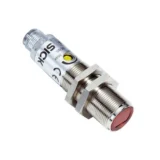
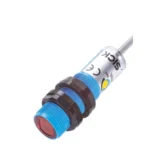
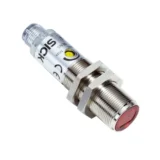
Description
SICK VTF180-2N41112 NPN Focused Diffuse Sensor
Technical Overview
The SICK VTF180-2N41112 is an energetic photoelectric proximity sensor with focused visible-red optics and an NPN output. It evaluates light reflected by the target from one mounting side, avoiding a separate reflector or receiver across the detection area. The specified sensing range is 1–100 mm and the maximum range is 1–140 mm on a white reference target having 90% remission. A 645 nm LED forms an 8 mm spot at 100 mm, while a 270° potentiometer adjusts reception. Response of no more than 0.5 ms, 1,000 Hz switching, a 2 m cable and an IP67 nickel-plated brass and PC housing support machine integration.
Focused energetic sensor with 1–100 mm reference-target sensing, NPN output, 270° adjustment, 1,000 Hz switching and 2 m cable.
Key Features
- Energetic diffuse photoelectric sensing
- Focused optics with 645 nm visible red LED
- 1–100 mm sensing range on 90% remission reference white
- 1–140 mm maximum range on 90% remission reference white
- Ø8 mm spot at 100 mm
- 270° sensing-range potentiometer
- NPN output; L/D control connection; open = light switching
- Response ≤0.5 ms; 1,000 Hz switching
- 2 m four-wire PVC cable; 0.18 mm² conductors
- Axial M18 × 1 nickel-plated brass and PC housing; IP67; two nuts supplied
Technical Specification Matrix
| Parameter | Value |
|---|---|
| Functional principle | Energetic photoelectric proximity sensor |
| Sensing range | 1–100 mm on 90% remission white target (DIN 5033) |
| Maximum sensing range | 1–140 mm on 90% remission white target (DIN 5033) |
| Light source | LED, visible red light |
| Light spot size | Ø8 mm at 100 mm |
| Adjustment | Potentiometer, 270°, for sensing range |
| Optical axis | Axial |
| Housing form | Cylindrical, M18 × 1 |
| Power supply | 10–30 V DC; short-circuit-protected network max. 8 A |
| Residual ripple | ±10%; remain within supply-voltage limits |
| Current consumption | 30 mA without load |
| Switching output | NPN |
| Switching mode | Light/dark switching, selectable via L/D control connection; control connection open = light switching L.ON |
| Output current | ≤100 mA |
| Response time | ≤0.5 ms with resistive load |
| Switching frequency | 1,000 Hz at light/dark ratio 1:1 |
| Connection | 4-wire, 2 m PVC cable; do not bend below 0 °C |
| Circuit protection | Supply/input/output reverse-polarity protection and output overcurrent/short-circuit protection |
| Protection class | III |
| Housing material | Metal, nickel-plated brass and PC |
| Optics material | PMMA plastic |
| IP rating | IP67 |
| Operating temperature | −25 to +55 °C |
| Conductor cross-section | 0.18 mm² |
| Cable diameter | Ø3.8 mm |
| Dimensions L x W x H (cm) | 6.25 x 1.8 x 1.8 |
| Physical Weight (kg) | 0.095 |
| Wavelength | 645 nm |
| Special feature | Focused optics |
| Items supplied | 2 fastening nuts |
| Storage temperature | −40 to +70 °C |
| NPN signal voltage HIGH/LOW | Approximately supply voltage / <1.8 V |
| MTTFD | 1,889 years |
| Diagnostic coverage DCavg | 0% |
Industrial Applications
1. Checking a workpiece in a fixture
An assembly fixture can position the sensor toward the expected face of an opaque workpiece, with clear optical separation from surfaces behind the detection point. Energetic sensing evaluates reflected target light, and the potentiometer sets reception for the installed geometry. The NPN output supplies the local presence state to the sequence controller.
A contactless workpiece signal identifies an occupied fixture for the controller, supporting assembly sequencing without a mechanical feeler pressing against the part at the sensing position.
2. Counting separated components on a conveyor
A conveyor can aim the sensor at a position crossed by separated opaque parts so each target presents reflected light to the receiver. The 8 mm at 100 mm optical spot defines the monitored region, while the potentiometer adapts reception to the target and background geometry. The 1,000 Hz switching frequency supports repeated transitions within the documented timing limits.
Discrete reflected-light transitions mark individual part passages without contact, giving the controller a count input when the installed geometry separates each target from the empty path.
3. Checking opaque strip continuity
A feeder can direct the sensor toward an opaque strip at a fixed monitoring position so reflected light indicates material present. A break or runout removes the target from that optical position and changes the NPN signal. IP67 protection supports exposed machine mounting, while the 2 m cable connects to local control wiring.
A change in local material presence provides an electrical indication of interrupted strip feed, helping the controller coordinate a response before additional product enters the affected process section.