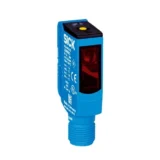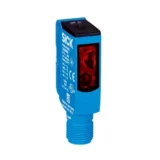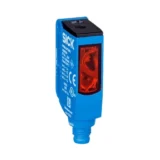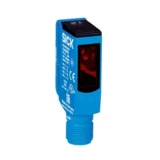
Description
SICK WL9G-3P1132 PNP Transparent-object Sensor
Technical Overview
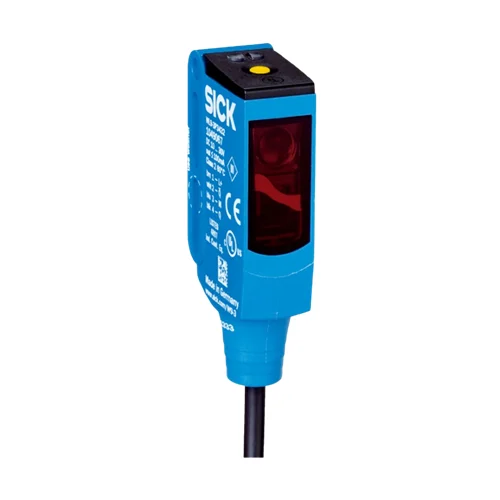
The SICK WL9G-3P1132 is a retro-reflective photoelectric sensor configured for detecting transparent objects. Polarized autocollimation/coaxial optics provide 0–3 m sensing with a PL80A reflector, with 0–5 m maximum range specified separately and no reflector minimum distance. A single local teach-in button sets detection, and AutoAdapt is present. The 650 nm red PinPoint LED produces a 45 mm spot at 1.5 m. Complementary PNP outputs provide light/dark switching, with Q defined as light switching. Response is below 0.5 ms with resistive load, with a 1,000 Hz switching rating. The device uses a 2 m four-wire PVC cable, M3 mounting holes and an IP66/IP67/IP69K VISTAL housing with PMMA optics.
Transparent-object retro-reflective sensor with 0–3 m PL80A sensing, local teach-in, AutoAdapt, complementary PNP outputs and 2 m four-wire PVC cable.
Key Features
- Dedicated transparent-object detection with polarized retro-reflective coaxial optics
- 0–3 m sensing range with PL80A reflector; 0–5 m maximum range
- 650 nm red PinPoint LED; Ø45 mm light spot at 1.5 m
- Single local teach-in button; AutoAdapt present
- Complementary PNP outputs; Q is light switching and inverse Q is dark switching
- Response <0.5 ms with resistive load; 1,000 Hz at 1:1 light/dark ratio
- 2 m four-wire PVC cable
- 10–30 V DC; 20 mA consumption without load; output current derated to 50 mA at ≥+50 °C
- VISTAL plastic housing and PMMA optics; IP66/IP67/IP69K
- M3 mounting holes; green power and yellow received-light indicators
Technical Specification Matrix
| Parameter | Value |
|---|---|
| Functional principle | Photoelectric retro-reflective sensor |
| Optical arrangement | Autocollimation/coaxial optics; without reflector minimum distance |
| Special application | Detecting transparent objects |
| Housing design | Rectangular |
| Sensing range | 0–3 m with PL80A reflector |
| Maximum sensing range | 0–5 m with PL80A reflector |
| Other reflector ranges | Sensing / maximum: P250F 0–2 / 0–3.5 m; PL40A 0–2 / 0–4 m; PL20F 0–1.3 / 0–2.2 m; PL10F 0–1.2 / 0–1.6 m; REF-IRF-56 tape 0–0.5 / 0–0.8 m |
| Light source | Visible red PinPoint LED |
| Wavelength | 650 nm |
| Average LED service life | 100,000 h at +25 °C |
| Light spot size | Ø45 mm at 1.5 m |
| Additional light spot sizes | Ø25 mm at 1 m; Ø60 mm at 2 m; Ø120 mm at 3.5 m; Ø160 mm at 5 m |
| Adjustment | Single local teach-in button |
| AutoAdapt | Present |
| Polarizing filter | Present |
| Switching output | Complementary PNP outputs Q and inverse Q |
| Switching mode | Light/dark switching; Q is light switching |
| Output current | ≤100 mA; at ambient temperature ≥+50 °C, maximum load current is 50 mA |
| Response time | <0.5 ms signal transit time with resistive load |
| Switching frequency | 1,000 Hz with 1:1 light/dark ratio |
| Power supply | 10–30 V DC in short-circuit-protected network, maximum 8 A |
| Ripple | <5 Vpp; remain within supply-voltage tolerances |
| Current consumption | 20 mA without load |
| Connection | 2 m four-wire PVC cable |
| Pin assignment | CD-094: BN=L+; WH=inverse Q; BU=M; BK=Q |
| Circuit protection | Supply reverse-polarity protection; inputs and output reverse-polarity protection; interference suppression |
| Protection class | III |
| Housing material | VISTAL® plastic |
| Optics material | PMMA plastic |
| IP rating | IP66 / IP67 / IP69K |
| Mounting | M3 mounting holes; Ø3.1 mm in manufacturer drawing |
| Indication | Yellow LED: received-light status; green LED: power on |
| Operating temperature | −40 to +60 °C |
| Storage temperature | −40 to +75 °C |
| UL file | NRKH.E181493 |
| MTTFD | 1,232 years |
| DCavg | 0% |
| Cable material | PVC plastic; do not bend below 0 °C |
| Conductor cross-section | 0.14 mm² |
| Physical Weight (kg) | 0.08 |
Industrial Applications
1. Counting separated transparent containers on a conveyor
A packaging conveyor can move separated transparent containers through the optical path between the sensor and a facing reflector. The dedicated transparent-object configuration and single teach-in button establish detection using representative containers. External counting electronics evaluate PNP output transitions, with setup checking container geometry, reflector alignment and spacing within the specified PL80A sensing range rather than the separate maximum range.
A taught change in received light provides container-passage events to external counting electronics, helping register transparent containers that transmit much of the incident beam.
2. Monitoring continuity of a transparent strip at a material guide
A material guide can hold a transparent strip in a defined path between the sensor and reflector. Teaching establishes the received-light change produced by the actual strip, and a break or missing section changes that condition. External handling logic evaluates the complementary PNP signals after threading, while guide geometry keeps normal lateral movement from clearing the monitored beam.
A change at the taught optical threshold gives external strip-handling logic a continuity reference, helping identify missing transparent material at a constrained guide location.
3. Checking a transparent tray presented in a loading nest
A loading nest can bring a transparent tray wall into a repeatable optical path before an insertion step. The sensor faces a fixed reflector, and button teaching establishes the actual tray-present condition. External station logic samples the complementary PNP outputs after the tray settles, with commissioning checking the tray wall geometry and optical change at the installed reflector distance.
A taught tray-present condition helps external loading logic distinguish an occupied nest from an empty presentation point before the next ordinary assembly operation begins.