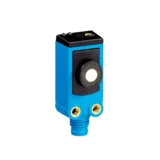
Description
SICK UC4-11345 NPN Ultrasonic Sensor
Technical Overview
The SICK UC4-11345 detects natural objects using ultrasonic echoes over a 13–100 mm operating range,with a separate 150 mm limiting range. One NPN output reports a taught switching condition;teach-in starts at21 mm. Distance-to-object,window and background modes,output inversion and a deactivatable local teach button adapt setup. The specified response is24 ms,switching frequency30 Hz and output time8 ms. This version has no temperature compensation and specifies0.17%/K drift relative to the current measured value. The straight-sensing ABS unit has two LEDs and an M8 three-pin male connector,with IP65/IP67 protection. For operation above50 °C,the rear surface must sit flat against a mounting bracket.
13–100 mm ultrasonic sensor with one NPN output,teach-in from21 mm,24 ms response and M8 three-pin connection.
Key Features
- 13–100 mm operating range;150 mm limiting range
- Teach-in starts at21 mm
- One NPN digital output;maximum current≤200 mA
- Distance-to-object,window and background modes;invertible output
- Local teach button;button deactivation and factory reset
- 24 ms response;30 Hz switching;8 ms output time
- No temperature compensation;0.17%/K drift relative to current value
- 15–30 V DC;≤0.75 W without load;startup<300 ms
- M8 three-pin male connector;two LEDs;M3 mounting threads
- IP65/IP67 ABS housing;above50 °C rear must contact bracket flat
Technical Specification Matrix
| Parameter | Value |
|---|---|
| Functional principle | Ultrasonic object/distance detection |
| Operating range | 13–100 mm |
| Limiting range | 150 mm;distinct from operating range |
| Minimum teach distance | 21 mm |
| Detection area | Depends on reflection,size and alignment;reference diagrams use aligned100 ×100 mm plate andØ10 mm cylindrical bar |
| Resolution | ≥0.1 mm |
| Repeatability | ±0.15% of current measured value;minimum value≥resolution |
| Measurement accuracy | ±1% of current measured value |
| Temperature compensation | Not available |
| Response time | 24 ms |
| Switching frequency | 30 Hz |
| Output time | 8 ms |
| Ultrasonic frequency | Typical380 kHz;acoustic frequency |
| Digital output | 1 ×NPN;maximum current≤200 mA;short-circuit protected |
| Switching modes | Switching point(DtO),window,background(ObSB) |
| Adjustment | Local teach-in,invert output,deactivate teach button,reset factory settings |
| Hysteresis | 2 mm |
| Power supply | 15–30 V DC;limit values;reverse-polarity protected |
| Supply network requirement | Short-circuit protected network,max8 A |
| Power consumption | ≤0.75 W without load |
| Initialization time | <300 ms |
| Indicators | Orange:digital output;green:supply active |
| Connection | M8 three-pin male connector |
| Pin assignment | 1BN=L+;3BU=M/0 V;4BK=Q/invertedQ |
| Mounting | M3 threaded mounting holes |
| Multiple-sensor separation | Parallel>250 mm;opposite>1,300 mm |
| Sending axis | Straight |
| Housing material | ABS plastic |
| Transducer materials | Polyurethane foam and glass epoxy resin |
| IP rating | IP65/IP67 |
| Protection class | III |
| Operating temperature | −25 to+70 °C;above50 °C rear surface must lie flat against a bracket |
| Storage temperature | −40 to+85 °C |
| MTTFD | 101 years |
| DCavg | 0% |
| Physical Weight (kg) | 0.01 |
| Temperature drift | 0.17%/K relative to current measured value |
Industrial Applications
1. Checking a small part at a fixture reference
A fixture can present a sufficiently reflecting part surface inside the 13–100 mm operating range and teach its reference condition at a distance of at least21 mm. The single NPN output reports the selected condition to external inspection control. Actual target size,alignment and temperature behavior are checked before choosing the switching threshold and matching the24 ms response to the machine sequence.
A taught surface-distance condition gives external inspection control a repeatable reference for a small part,helping it identify a displaced or missing surface before the next fixture operation.
2. Checking a load face within a taught window
A compact handling station can teach two window boundaries for an expected load face,with teach points between21 and100 mm. External sequence control interprets the configured output state as the selected window condition. Actual surface reflection and alignment are validated,and the teach button can be deactivated after setup to retain the chosen operating configuration.
A distance window supplies external handling control with an acceptance zone for the load face,helping distinguish a load placed too near or too far before a transfer action.
3. Detecting material in front of a reflecting background
A material station can teach a stable background at least21 mm from the sensor and inside the 13–100 mm operating range. Objects then pass between the sensor and that background,and external control uses the configured background-mode result. The actual material and background returns are checked,with the30 Hz switching specification considered for the intended presentation cycle.
A taught background condition lets external sequence control distinguish material occupying the selected space from the background alone,providing a distance-based check when reflected optical contrast is limited.