Description
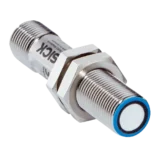
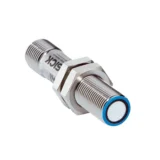
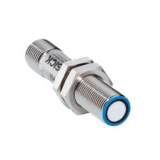
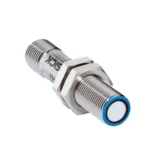
SICK UM12-1192271 Analog Ultrasonic Distance Sensor
Technical Overview
The SICK UM12-1192271 uses ultrasonic echoes to measure natural objects within a 40–240 mm operating range and provides one 0–10 V analog output. External teach-in adapts the analog characteristic, which can also be inverted. The 350 mm limiting range is distinct from the operating range, and the detection area depends on target reflection, size and alignment. Output resolution is 12 bit, output time is 10 ms and response is 30 ms before application-dependent smoothing, which may increase response time by up to 200%. The temperature-compensated sensor has an M12 threaded nickel-plated brass/PBT body, two LEDs and an M12 four-pin connector, with IP65/IP67 protection.
40–240 mm ultrasonic distance sensor with a 0–10 V analog output,12-bit output resolution,external teach-in and M12 four-pin connection.
Key Features
- 40–240 mm operating range;350 mm limiting range
- One 0–10 V analog output;load≥100,000 Ω
- 12-bit analog-output resolution
- External teach-in and invertible analog characteristic
- 30 ms response;smoothing may increase response time by up to200%
- 10 ms output time;typical500 kHz acoustic frequency
- Temperature compensation;accuracy±1% of current measurement
- M12 ×1 threaded body;M12 four-pin male connector
- 15–30 V DC;≤1.2 W without load;initialization<300 ms
- IP65/IP67 nickel-plated brass/PBT housing;−25 to+70 °C operation
Technical Specification Matrix
| Parameter | Value |
|---|---|
| Functional principle | Ultrasonic distance sensing |
| Measuring object | Natural objects |
| Operating range | 40–240 mm |
| Limiting range | 350 mm;distinct from operating range |
| Detection area | Depends on reflection properties,size and alignment;reference diagrams use aligned500 ×500 mm plate andØ10 mm cylindrical bar |
| Resolution | ≥0.069 mm |
| Repeatability | ±0.15% of current measured value;minimum value≥resolution |
| Measurement accuracy | ±1% of current measured value |
| Temperature compensation | Internal;optimum operating point after1 min;factory setting uses aluminum mounting bracket and mounting nuts |
| Response time | 30 ms;subsequent analog smoothing may increase response time by up to200%,depending on application |
| Output time | 10 ms |
| Ultrasonic frequency | Typical500 kHz;acoustic frequency |
| Power supply | 15–30 V DC;limit values;reverse-polarity protected |
| Supply network requirement | Short-circuit protected network,max8 A,Class2 |
| Power consumption | ≤1.2 W without load |
| Initialization time | <300 ms |
| Indicators | Green supply LED;orange analog-output/status LED |
| Connection | M12 four-pin male connector |
| Pin assignment | 1BN=L+;3BU=M/0 V;4BK=QA analog output;2WH=Teach-in |
| Mounting thread | M12 ×1 |
| Mounting nuts | 17 mm across flats;maximum tightening torque1 Nm |
| Sending axis | Straight |
| Housing material | Nickel-plated brass and PBT |
| Transducer materials | Polyurethane foam and glass epoxy resin |
| IP rating | IP65/IP67 |
| Protection class | III |
| Operating temperature | −25 to+70 °C |
| Storage temperature | −40 to+85 °C |
| MTTFD | 101 years |
| DCavg | 0% |
| Physical Weight (kg) | 0.015 |
| Analog output | 1 ×0–10 V;load≥100,000 Ω |
| Analog-output resolution | 12 bit |
| Analog adjustment | External teach-in,invert analog output,reset to factory defaults |
Industrial Applications
1. Following a small-container fill level
A compact container can present a sufficiently reflecting material surface within40–240 mm and use the taught 0–10 V output to pass distance information to an external level controller. The controller converts the signal using the installed reference geometry. Echo behavior,temperature-compensation settling and analog smoothing are validated on the actual surface before choosing the required control response.
An analog surface-distance signal lets external control follow a changing level across the taught span,providing information for replenishment or filling decisions between fixed high and low thresholds.
2. Monitoring a material loop position
A machine can place a suitably aligned,echo-producing material loop surface within the40–240 mm operating range and teach the analog output over the required excursion. The 0–10 V signal reaches an external feed controller,which applies the correction strategy. Target geometry and smoothing are checked against the expected movement so response settings remain appropriate to the process.
Continuous position information allows external feed control to evaluate how far a material loop has moved from its reference, supporting a chosen correction strategy across the taught excursion.
3. Estimating roll size from a surface distance
A roll station can present an adequately reflecting outer surface within40–240 mm and transmit its distance-related 0–10 V signal to an external controller. With the roll axis and sensor reference fixed,the controller derives a diameter estimate from the installed geometry. Actual echo return,target alignment and analog response are checked as the roll turns;the sensor itself supplies distance rather than a dedicated diameter calculation.
A distance-derived roll-size estimate gives external control a changing reference for unwind or rewind planning,helping it follow material consumption without relying only on a single end-of-roll threshold.