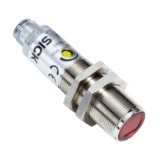
Description
SICK VL180-2P42436 PNP Retro-reflective Sensor with Reflector
Technical Overview
The SICK VL180-2P42436 is an axial polarized dual-lens retro-reflective sensor with a PNP output. With PL80A, sensing spans 0.05–6 m and maximum range is 0.05–7 m. The supplied P250 reflector provides 0.05–4.5 m sensing and 0.05–6 m maximum range. Its 645 nm red LED produces a 400 mm spot at 6 m, with approximately 4.5° dispersion. A 270° potentiometer adjusts sensitivity; an L/D control input selects output behavior, with an open control wire giving dark switching. Response is no more than 0.5 ms with resistive load, with 1,000 Hz switching at a 1:1 light/dark ratio. The IP67 PBT/PC and PMMA device uses 10–30 V DC, an M12 four-pin connector and M18 × 1 mounting. Two PC fastening nuts are supplied.
Axial M18 retro-reflective sensor with PNP output, 270° sensitivity adjustment, L/D control input, M12 four-pin connector and supplied P250 reflector.
Key Features
- Axial polarized dual-lens retro-reflective sensing; minimum reflector distance required
- PL80A: 0.05–6 m sensing; 0.05–7 m maximum range
- Supplied P250: 0.05–4.5 m sensing; 0.05–6 m maximum range
- 645 nm red LED; Ø400 mm spot at 6 m; approximately 4.5° dispersion
- 270° sensitivity potentiometer
- PNP output; ≤100 mA; L/D control input, open wire gives dark switching
- ≤0.5 ms response with resistive load; 1,000 Hz at 1:1 light/dark ratio
- 10–30 V DC; 30 mA without load; M12 four-pin male connector
- PBT/PC housing; PMMA optics; IP67; M18 × 1 thread
- P250 reflector and two PC fastening nuts, 22 mm across flats, supplied
Technical Specification Matrix
| Parameter | Value |
|---|---|
| Functional principle | Photoelectric retro-reflective sensor |
| Optical design | Axial polarized dual-lens system; minimum reflector distance required |
| Sensing range | 0.05–6 m with PL80A; 0.05–4.5 m with supplied P250 |
| Maximum sensing range | 0.05–7 m with PL80A; 0.05–6 m with P250 |
| Reflector ranges | Sensing / maximum: PL80A 0.05–6 / 0.05–7 m; P250, PL40A, PL50A and C110A 0.05–4.5 / 0.05–6 m; PL30A and PL31A 0.05–3.5 / 0.05–4.5 m; PL20A 0.05–2.3 / 0.05–3 m; P45 0.05–1.8 / 0.05–2.2 m; Diamond Grade tape 0.1–1.4 / 0.1–1.8 m |
| Light source | Visible red LED |
| Wavelength | 645 nm |
| Light spot size | Ø400 mm at 6 m |
| LED service life | Average 100,000 h at ambient +25 °C |
| Focus / dispersion angle | Approximately 4.5° |
| Adjustment | Sensitivity potentiometer, 270° |
| Switching output | PNP |
| Switching mode | Light/dark switching via L/D control input; open control wire gives dark switching (D.ON) |
| Signal voltage HIGH/LOW | Approximately supply voltage −1.8 V / 0 V |
| Output current | ≤100 mA |
| Response time | ≤0.5 ms with resistive load |
| Switching frequency | 1,000 Hz at 1:1 light/dark ratio |
| Power supply | 10–30 V DC; limit values in a short-circuit-protected network, maximum 8 A |
| Ripple | ±10%; remain within supply tolerances |
| Current consumption | 30 mA without load |
| Connection | M12 four-pin male connector |
| Pin assignment | CD-087: 1 BN=L+; 2 WH=L/D; 3 BU=M; 4 BK=Q |
| Circuit protection | A: supply reverse-polarity protection; B: inputs and output reverse-polarity protection; D: outputs overcurrent and short-circuit protection |
| Protection class | III |
| Housing material | PBT/PC plastic |
| Optics material | PMMA plastic |
| Mounting thread | M18 × 1 |
| IP rating | IP67 |
| Items supplied | P250 reflector; two PC fastening nuts, 22 mm across flats |
| Indicators | Orange: switching output active; green: strength indicator |
| Operating temperature | −25 to +55 °C |
| Storage temperature | −40 to +70 °C |
| UL files | NRKH2.E300503 and NRKH8.E300503 |
| MTTFD | 2,006 years |
| DCavg | 0% |
| Physical Weight (kg) | 0.018 |
Industrial Applications
1. Counting separated cartons across a conveyor
A conveyor can position the sensor and a suitable reflector on opposite sides of a load path so opaque cartons interrupt the returned red beam. External counting logic evaluates the PNP signal. Commissioning checks reflector spacing, alignment, carton coverage, load gaps and transit speed against the documented reflector ranges, response time and switching frequency before registering passage events.
A carton-passage reference gives an external counter a defined optical event across the conveyor, using beam interruption and a reflector arrangement checked for the actual load path.
2. Monitoring opaque web continuity at a feed point
A material feed can route an opaque web through the reflected optical path between the sensor and a reflector. External process logic samples the PNP signal to evaluate material presence and recognize a break. Setup checks web movement, optical coverage, alignment and the reflector-specific minimum separation, keeping the beam reliably covered throughout normal feed conditions.
A beam-interruption reference helps external process logic recognize loss of opaque feed at the checked location, using a material path that blocks the reflected beam during normal operation.
3. Checking transfer-path occupancy at a stop
A transfer stop can present an opaque carrier across the sensor-to-reflector path at a defined seated position. External sequencing logic samples the PNP state after the carrier settles and coordinates acceptance or release. Installation checks reflector distance, alignment, carrier coverage and possible openings through the carrier so the occupied condition remains distinguishable from the clear path.
A carrier-occupancy reference helps external sequencing logic coordinate a transfer step, using a defined optical interruption checked at the actual stopped position before release.