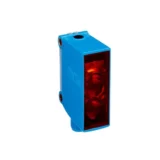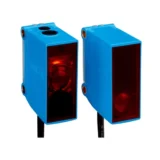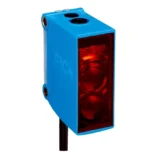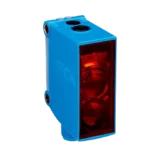
Description
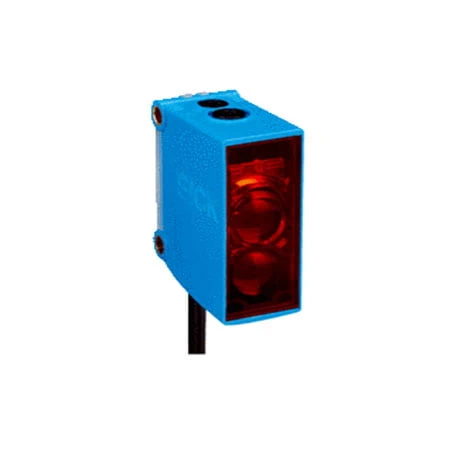
SICK GTE10-N1211 NPN Diffuse Photoelectric Sensor
Technical Overview
The SICK GTE10-N1211 is an energetic photoelectric proximity sensor with an NPN switching output and visible red PinPoint LED illumination. The sensor evaluates light reflected by the target from one mounting side, avoiding a separate receiver or reflector across the detection area. Its specified 40–950 mm sensing range and 20–1,300 mm maximum range apply to a white reference target having 90% remission. A 270° sensitivity potentiometer and selectable light/dark switching adapt detection and control logic. The 625 nm light source, response of no more than 500 µs, 1,000 Hz operation, 2 m cable and IP67 ABS/PMMA housing support machine integration.
NPN energetic photoelectric sensor with 40–950 mm reference-target range, sensitivity adjustment, 1,000 Hz switching, 2 m cable and IP67 housing.
Key Features
- Energetic reflected-light detection
- 40–950 mm sensing range on 90% remission reference white
- 20–1,300 mm maximum range on 90% remission reference white
- 625 nm visible red PinPoint LED
- Ø 28 mm spot at 1,400 mm
- 270° sensitivity potentiometer
- NPN output with selectable light/dark switching
- Response ≤ 500 µs; 1,000 Hz switching
- 10–30 V DC operation and 2 m PVC cable
- IP67 ABS/PMMA housing; −30 to +60 °C operation
Technical Specification Matrix
| Parameter | Value |
|---|---|
| Functional principle | Energetic photoelectric proximity sensor |
| Maximum sensing range | 20–1,300 mm on 90% remission white target (DIN 5033) |
| Light source | PinPoint LED, visible red light |
| Wavelength | 625 nm |
| Light spot size | Ø 28 mm at 1,400 mm |
| Adjustment | Potentiometer, 270° |
| Conductor cross-section | 0.14 mm² |
| Power supply | 10–30 V DC; short-circuit-protected network, max. 8 A |
| Residual ripple | < 5 Vpp; remain within supply-voltage limits |
| Current consumption | 20 mA |
| Switching output | NPN |
| Switching mode | Light/dark switching; selectable via selector |
| Output current | ≤ 100 mA |
| Response time | ≤ 500 µs with resistive load |
| Switching frequency | 1,000 Hz at light/dark ratio 1:1 |
| Connection | 3-wire, 2 m PVC cable; do not bend below 0 °C |
| Circuit protection | Supply/input/output reverse-polarity protection, interference suppression and output overcurrent/short-circuit protection |
| Protection class | III |
| Housing form | Rectangular |
| Housing material | ABS/PMMA plastic |
| IP rating | IP67 |
| EMC standard | EN 60947-5-2 |
| Operating temperature | −30 to +60 °C |
| Storage temperature | −40 to +70 °C |
| UL file | NRKH.E348498 & NRKH7.E348498 |
| Conditional standard | UL325 when used with a sturdy protective hood, for example BEF-G10WSG (2071960) |
| Dimensions L x W x H (cm) | 3.9 x 2 x 5 |
| Physical Weight (kg) | 0.09 |
| Sensing range | 40–950 mm on 90% remission white target (DIN 5033) |
Industrial Applications
1. Part arrival at an assembly fixture
An assembly station needs a signal when an opaque component reaches its loading position. The energetic photoelectric sensor illuminates the target and evaluates the reflected red light from the same mounting side. Its 270° sensitivity potentiometer adapts detection to the installed target and distance, while the switching output reports arrival to the machine sequence.
A single sensor body provides a contactless arrival signal where mounting a separate receiver is inconvenient, helping the controller start the next assembly step with the component present.
2. Opaque package counting on a short-range conveyor
A conveyor carrying separated opaque packages can use reflected-light detection to create an event as each package passes the sensing position. The 1,000 Hz switching frequency and response of no more than 500 µs support distinct signal transitions within the specified timing limits. A visible red spot helps locate the detection point during installation without a receiver on the opposite side.
Package passages become electrical switching events for a machine counter, while one-sided optical installation reduces the hardware needed across a narrow conveyor or enclosed transport path.
3. Detecting a nearly empty parts chute
A parts feeder can monitor whether opaque components remain at a selected height in its supply chute. With a stable target surface and a clear optical view, reflected-light detection changes state when that location empties. Selectable light/dark switching supports the desired controller logic, and the IP67 housing protects the sensor at an exposed machine mounting point.
A discrete presence signal at the selected chute height supports replenishment requests before the feed path empties completely, reducing reliance on repeated manual visual inspection.