Description
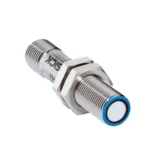
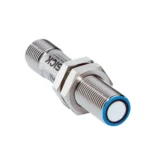
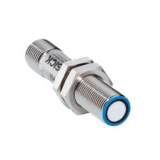
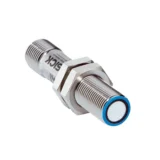
SICK UM12-1172261 Current-output Ultrasonic Distance Sensor
Technical Overview
The SICK UM12-1172261 uses ultrasonic echoes to evaluate object distance within a 20–150 mm operating range, with a separate 250 mm limiting range. It provides one 12-bit 4–20 mA output with teach-in, inversion and factory-reset functions. Output load is limited to 500 Ω, reducing to 100 Ω at supply voltages of 20 V or less. Temperature compensation supports distance evaluation, while target reflection, size and alignment determine the detection area. Response is 24 ms before application-dependent analog smoothing, which can increase response time by up to 200%; output time is 8 ms. The M12 threaded nickel-plated brass/PBT sensor has a four-pin M12 connector, two LEDs and IP65/IP67 protection.
20–150 mm ultrasonic distance sensor with a taught 12-bit 4–20 mA output, temperature compensation and M12 four-pin connection.
Key Features
- 20–150 mm operating range; 250 mm limiting range
- One 4–20 mA output with 12-bit output resolution
- Output load ≤500 Ω; ≤100 Ω at supply ≤20 V
- Teach-in, invertible analog characteristic and factory reset
- Temperature compensation; accuracy ±1% of current measured value
- Repeatability ±0.15% of current value, minimum ≥resolution; resolution ≥0.069 mm
- 24 ms response before smoothing; 8 ms output time; typical 380 kHz acoustic frequency
- 10–30 V DC; ≤0.9 W without load; initialization <300 ms
- M12 × 1 cylindrical body; straight sending axis; four-pin M12 male connector
- Nickel-plated brass/PBT housing; IP65/IP67; −25 to +70 °C operation
Technical Specification Matrix
| Parameter | Value |
|---|---|
| Functional principle | Ultrasonic distance sensing |
| Operating range | 20–150 mm |
| Limiting range | 250 mm |
| Detection area | Depends on reflection properties, size and alignment; reference examples: aligned 500 × 500 mm plate and Ø10 mm cylindrical bar |
| Resolution | ≥0.069 mm |
| Repeatability | ±0.15% of current measured value; minimum value ≥resolution |
| Measurement accuracy | ±1% of current measured value |
| Temperature compensation | Provided |
| Response time | 24 ms; subsequent application-dependent analog smoothing may increase response time by up to 200% |
| Output time | 8 ms |
| Ultrasonic frequency | Typical 380 kHz |
| Analog output | One 4–20 mA current output |
| Output load | ≤500 Ω; maximum ≤100 Ω at supply ≤20 V |
| Analog output resolution | 12 bit |
| Analog adjustment | Teach-in, inversion and reset to factory defaults; functions may vary by sensor type |
| Power supply | 10–30 V DC; limit values; reverse-polarity protected |
| Supply network | Short-circuit-protected network, max. 8 A, Class 2 |
| Power consumption | ≤0.9 W without load |
| Initialization time | <300 ms |
| Indicators | Two LEDs: green supply indicator; orange analog/switching-output status indication |
| Connection | M12 four-pin male connector |
| Pin assignment | 1 BN=L+; 4 BK=QA; 3 BU=M; 2 WH=Teach-in |
| Design | Cylindrical; straight sending axis |
| Mounting thread | M12 × 1 |
| Mounting nuts | 17 mm across flats |
| Housing material | Nickel-plated brass and PBT |
| Transducer materials | Polyurethane foam and glass epoxy resin |
| Housing length | 60.1 mm |
| IP rating | IP65/IP67 |
| Protection class | III |
| Operating temperature | −25 to +70 °C |
| Storage temperature | −40 to +85 °C |
| MTTFD | 101 years |
| DCavg | 0% |
| Physical Weight (kg) | 0.015 |
Industrial Applications
1. Following the fill level in a small container
A small container can present an adequately reflecting material surface within the 20–150 mm operating range and pass its distance-related current signal to an external level controller. The taught analog span establishes the electrical reference. Commissioning checks echo return, surface alignment and analog smoothing, while the connected input respects the load limit for the installed supply voltage.
A continuous surface-distance signal lets external level logic follow changes across the taught span, supporting filling or replenishment decisions between configured process limits.
2. Monitoring the position of a material loop
A feed machine can present a suitably aligned material-loop surface to the ultrasonic head and teach the current output over its expected movement. External feed-control logic compares that distance signal with a commissioned reference and applies its correction strategy. Setup validates actual reflection properties, target coverage and response before selecting operating speeds and analog smoothing.
A changing distance reference lets external feed-control logic evaluate loop movement relative to its desired position, helping coordinate material delivery across the taught excursion.
3. Estimating the remaining size of a small roll
A roll station can place the reflecting outer surface within the sensor’s operating range and read the taught 4–20 mA signal as the roll changes size. An external controller uses the fixed sensor-to-axis geometry to estimate roll diameter. Commissioning checks echo behavior, alignment and smoothing on the rotating surface; the sensor supplies distance rather than calculating diameter.
A distance-derived roll-size estimate gives external control a changing reference for material-consumption planning, supporting a replenishment decision before a configured minimum roll size is reached.