Description
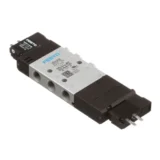
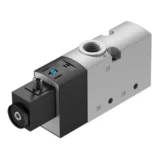
Festo MHE2-MS1H-3/2G-M7 Direct-Acting Solenoid Valve
Technical Overview
The Festo MHE2-MS1H-3/2G-M7 is a direct-acting, normally closed 3/2-way solenoid valve with mechanical spring reset and 100 l/min standard nominal flow. Its 10 mm body uses a M7 working ports, a 2 mm nominal passage and a 14 mm mounting grid with 4 mm minimum spacing between valves. At 24 V DC, specified switching times are 1.7 ms on and 2 ms off, with holding-current reduction and a two-pin plug. The normal pressure range is −0.9 to 8 bar, restricted to −0.9 to 1 bar for reversible operation. The 60 g IP65 assembly has temperature limits dependent on switching frequency.
Direct-acting normally closed 3/2-way M7 valve with 100 l/min nominal flow, 24 V DC actuation, 1.7 ms on/2 ms off timing and IP65.
Key Features
- Normally closed single-solenoid 3/2-way function with mechanical spring reset
- Direct-acting pressure-relief poppet construction; 2 mm nominal size
- 100 l/min standard nominal flow to DIN 1343
- 10 mm construction width and 14 mm grid; 4 mm minimum inter-valve spacing
- −0.9 to 8 bar operating range; reversible operation restricted to −0.9 to 1 bar
- 1.7 ms on and 2 ms off switching; +10%/−30% switching-time tolerances
- 330 Hz maximum switching frequency, subject to frequency-dependent temperature limits
- 24 V DC two-pin plug; coil high-current phase 5.0 W and low-current phase 1.25 W
- Holding-current reduction, spark arresting, protective circuit and bipolar reverse-polarity protection
- 60 g product weight, IP65, non-detenting manual override and Class 6 cleanroom suitability
Technical Specification Matrix
| Parameter | Value |
|---|---|
| Valve function | 3/2-way, single solenoid, closed |
| Type of actuation | Electrical |
| Construction width | 10 mm |
| Standard nominal flow rate (standardised to DIN 1343) | 100 l/min |
| pneumatic working port | M7 |
| Operating voltage | 24 V DC |
| Operating pressure | -0.09 MPa...0.8 MPa; -0.9 bar...8 bar; -13.05 psi...116 psi |
| Design | Pressure relief poppet valve |
| Type of reset | Mechanical spring |
| Degree of protection | IP65 |
| Approval | RCM; c UL us - Recognised (Oil) |
| CE mark (see declaration of conformity) | To EU EMC Directive; In accordance with EU RoHS Directive |
| UKCA marking (see declaration of conformity) | To UK instructions for EMC; To UK RoHS instructions |
| Nominal size | 2 mm |
| Mounting grid pitch | 14 mm |
| Minimum inter-valve spacing | Minimum distance between the valves is 4 mm |
| Exhaust-air function | Can be throttled |
| Sealing principle | Soft |
| Mounting position | Any |
| Manual override | Non-detenting |
| Type of piloting | Direct |
| Flow direction | Reversible with restrictions |
| lap | Underlap |
| Reverse polarity protection | Bipolar |
| Additional functions | Spark arresting; Holding current reduction; Protective circuit |
| Operating pressure, reversible | -0.09 MPa...0.1 MPa; -0.9 bar...1 bar; -13.05 psi...14.5 psi |
| Max. switching frequency | 330 Hz |
| Switching time off | 2 ms |
| Switching time on | 1.7 ms |
| Tolerance switching time off | +10%/-30% |
| Tolerance switching time on | +10%/-30% |
| Switching time dispersion from 1 Hz | 0.2 ms |
| Duty cycle | 100% |
| Characteristic coil data | 24 V DC: low-current phase 1.25 W, high-current phase 5.0 W |
| Permissible voltage fluctuations | +/-10% |
| Operating medium | Compressed air to ISO 8573-1:2010 [7:4:4] |
| Note on operating and pilot medium | Lubricated operation possible (in which case lubricated operation will; always be required) |
| Vibration resistance | Transport application test with severity level 2 to FN 942017-4 and EN; 60068-2-6 |
| Restrictions for environmental and media temperature | As a function of switching frequency (see graph) |
| Shock resistance | Shock test with severity level 2 to FN 942017-5 and EN 60068-2-27 |
| Corrosion resistance class CRC | 2 - Moderate corrosion stress |
| LABS (PWIS) conformity | VDMA24364-B1/B2-L |
| Cleanroom suitability, measured according to ISO 14644-14 | Class 6 according to ISO 14644-1 |
| Media temperature | -5 °C...60 °C |
| Ambient temperature | -5 °C...60 °C |
| Physical Weight (kg) | 0.06 |
| Electrical connection | 2-pin; Plug |
| Type of mounting | With through-hole |
| Pneumatic connection, port 1 | M7 |
| Pneumatic connection, port 2 | M7 |
| Pneumatic connection, port 3 | M7 |
| Note on materials | RoHS compliant |
| Material seals | HNBR; NBR |
| Material housing | Die-cast zinc, coated |
| Material screws | Galvanised steel |
Industrial Applications
1. Short Air Commands for a Release Nozzle
A packaging station commands a small air nozzle to help release a component at a process step. The normally closed 3/2-way valve provides supply-and-exhaust routing, with direct actuation and specified 1.7 ms on/2 ms off component switching times. Its 100 l/min nominal flow characterizes the valve; nozzle pulse duration also depends on tubing, connected volume and the electrical command.
Direct electrical actuation and documented switching times provide a defined valve response for a short air command, while the normally closed function supplies the required unactuated routing state.
2. Electrical Commands to a Pneumatic Pilot Circuit
An automated fixture uses a downstream pneumatic control element and needs an electrical-to-pneumatic command stage. This direct-acting 3/2 valve switches its working path from a 24 V DC command and returns by mechanical spring. M7 connections group the supply, working and exhaust interfaces at the valve station, while the two-pin plug defines the electrical connection.
The valve converts an electrical sequence command into a pneumatic switching state, with direct actuation and mechanical spring reset providing the command stage for the downstream circuit.
3. Restricted-Pressure Vacuum Path Switching
A handling circuit requires a small directional valve whose working paths can operate below atmospheric pressure. Festo permits reversible operation for this model within the restricted −0.9 to 1 bar pressure range, distinct from its ordinary −0.9 to 8 bar rating. The direct-acting design switches without a separate pilot-air pressure requirement, with M7 threads providing the three pneumatic interfaces.
Documented reversible low-pressure operation provides a valve basis for a vacuum-path circuit, while direct actuation avoids introducing a separate pneumatic pilot supply to switch that component.