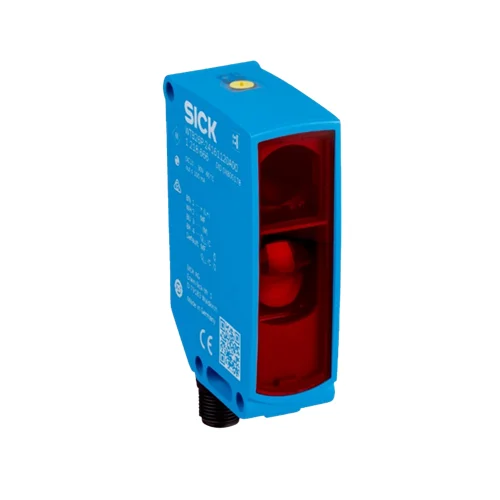
Description
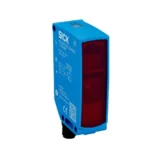
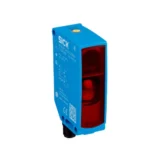
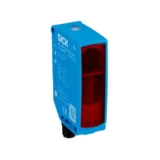
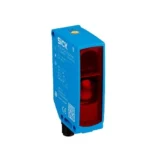
SICK WTF26P-24161420A00 Foreground Suppression Sensor
Technical Overview
The SICK WTF26P-24161420A00 is a photoelectric proximity sensor with foreground suppression for detecting flat objects in front of a defined background. Its visible 635 nm PinPoint LED produces a 7 mm spot at 700 mm, with a 200–800 mm adjustable threshold and a recommended working range of 250–500 mm. BluePilot Teach-Turn adjusts sensing range, while IO-Link configures parameters and Base logics Smart Task functions. Two complementary push-pull PNP/NPN outputs provide configurable light/dark behavior, with a 200 Hz switching rating and response no greater than 2.5 ms. The VISTAL housing has PMMA optics, an M12 four-pin male connector and IP66/IP67/IP69 protection for operation from −40 to +60 °C.
Foreground-suppression photoelectric sensor with BluePilot Teach-Turn, complementary push-pull outputs, IO-Link, 200 Hz switching and M12 connection.
Key Features
- Foreground suppression for flat-object detection against a defined background
- 0–800 mm reference-white range; 250–500 mm recommended working range
- 200–800 mm adjustable foreground-suppression threshold
- 635 nm PinPoint LED; Ø7 mm spot at 700 mm
- BluePilot Teach-Turn range adjustment and blue sensing-range indication
- Two complementary push-pull PNP/NPN outputs; ≤100 mA output current
- 200 Hz switching; ≤2.5 ms resistive-load response
- IO-Link V1.1 and Base logics Smart Task timers and logic functions
- M12 four-pin male connector; VISTAL housing and PMMA front screen
- IP66/IP67/IP69; −40 to +60 °C operation
Technical Specification Matrix
| Parameter | Value |
|---|---|
| Functional principle | Photoelectric proximity sensing with foreground suppression |
| Sensing range | 0–800 mm on 90% remission reference white, DIN 5033 |
| Adjustable foreground-suppression threshold | 200–800 mm |
| Recommended sensing range | 250–500 mm for best performance |
| Minimum object height example | 11 mm for a white 90% remission object in front of a black 6% remission background; sensor-to-background distance 500 mm |
| Manufacturer special application | Detecting flat objects |
| Light spot size | Ø7 mm at 700 mm |
| Adjustment | BluePilot Teach-Turn for sensing range; IO-Link for sensor parameters and Smart Task functions |
| Indicators | Blue: sensing-range indication; green: power on steadily, IO-Link flashing; yellow: on with object absent, off with object present |
| Default pin 4 function | BK: dark-switching output, object present → HIGH; IO-Link communication C |
| Default pin 2 function | WH: light-switching output, object present → LOW |
| Pin assignment | CD-390: 1 BN=L+; 3 BU=M; 4 BK=output / IO-Link C; 2 WH=multifunction output |
| Response time | ≤2.5 ms, signal transit with resistive load in switching mode |
| Response-time repeatability | 150 µs |
| Switching frequency | 200 Hz at 1:1 light/dark ratio |
| Smart Task switching frequency | SIO Logic: 200 Hz; IO-Link: 200 Hz |
| Smart Task response time | SIO Logic: 2.5 ms; IO-Link: 2.5 ms |
| Smart Task repeatability | SIO Logic: 300 µs; IO-Link: 400 µs |
| Diagnosis | Device status; quality of teach |
| Light source | Visible red PinPoint LED; 635 nm; point-shaped spot |
| Squint angle | <±1.0° at ambient +23 °C |
| LED photobiological classification | Free group; EN 62471:2008-09 / IEC 62471:2006, modified |
| Average LED service life | 100,000 h at ambient +25 °C |
| Communication interface | IO-Link V1.1; COM2, 38.4 kBaud |
| IO-Link cycle time | 2.3 ms |
| Process data | 16 bit: bit 0=QL1; bit 1=QL2; bits 2–15 empty |
| IO-Link identification | Vendor ID 26; Device ID 0x800275 / 8389237 |
| Compatible master port | Type A; SIO mode supported |
| Power supply | 10–30 V DC, limit values |
| Ripple | ≤5 Vpp |
| Usage categories | DC-12 and DC-13 to EN 60947-5-2 |
| Current consumption | ≤30 mA without load at 24 V DC |
| Protection class | III |
| Switching outputs | Two complementary push-pull PNP/NPN outputs |
| Switching mode | Light/dark switching; pin functions configurable via IO-Link |
| PNP signal voltage HIGH/LOW | Approximately supply voltage −2.5 V / 0 V |
| NPN signal voltage HIGH/LOW | Approximately supply voltage / <2.5 V |
| Output current | ≤100 mA |
| Output circuit protection | Reverse-polarity, overcurrent and short-circuit protection |
| Output connection restriction | A switching output must not be connected to another output |
| Connection | M12 four-pin male connector |
| Housing design | Rectangular |
| Housing and male connector material | VISTAL plastic |
| Front screen material | PMMA plastic |
| Mounting holes | Ø5.2 mm |
| Maximum fixing-screw torque | 1.3 Nm |
| IP rating | IP66/IP67/IP69 to EN 60529 |
| IP69 designation note | Manufacturer states IP69 replaces IP69K to ISO 20653:2013-03 |
| Operating temperature | −40 to +60 °C |
| Storage temperature | −40 to +75 °C |
| Relative humidity | 35–95%, non-condensing |
| Shock resistance, 11 ms | 50 g; 25 positive and 25 negative shocks per X/Y/Z axis, 150 total; EN 60068-2-27 |
| Shock resistance, 6 ms | 50 g; 5,000 positive and 5,000 negative shocks per X/Y/Z axis, 30,000 total; EN 60068-2-27 |
| Vibration resistance | 10–2,000 Hz; 0.5 mm amplitude / 10 g; 20 sweeps per X/Y/Z axis at 1 octave/min; EN 60068-2-6 |
| EMC | EN 60947-5-2 |
| Cleaning-agent resistance | ECOLAB |
| UL files | NRKH.E181493 and NRKH7.E181493 |
| MTTFD | 626 years |
| DCavg | 0% |
| Mission time | 20 years |
| Smart Task | Base logics |
| Smart Task logic functions | Direct, AND, OR, window and hysteresis |
| Smart Task timer functions | Deactivated, switch-on delay, off delay, ON and OFF delay, impulse (one shot) |
| Smart Task inverter | Available |
| Physical Weight (kg) | 0.08 |
Industrial Applications
1. Checking a flat part against a defined background
A transfer fixture can present a flat part in front of a stable background and use foreground suppression to signal the changed optical condition. BluePilot Teach-Turn sets the threshold, with the actual part and background used during setup. The manufacturer illustrates an 11 mm minimum white-object height with a black background 500 mm from the sensor; that reference is specific to those remission and distance conditions.
A foreground-sensitive switching condition gives external inspection logic a part-present reference above the fixture background, helping identify a missing flat part before transfer continues.
2. Changing sensor settings with a machine recipe
A machine handling different part presentations can retain sensor parameters in its external recipe system and write the selected settings through IO-Link. The interface configures sensor parameters and Smart Task functions, while the quality-of-teach diagnosis supplies setup information. BluePilot sensing-range indication supports a local check when the machine presents the representative target and background for the selected recipe.
Digital parameter access gives external recipe control a defined way to apply sensor settings and review teaching information, helping coordinate setup when the presented part changes.
3. Qualifying sustained occupancy at a transfer position
A transfer station can use the foreground-suppression state to identify an item that remains above its reference background. A configured Smart Task switch-on delay qualifies sustained occupancy before the output changes, and external sequencing uses that event to hold upstream release. Timing design uses the documented 200 Hz and 2.5 ms Smart Task characteristics together with the selected delay.
A delayed occupancy event helps external sequencing distinguish a brief passage from an item retained at the transfer position, using sensor-side timing of the optical condition.