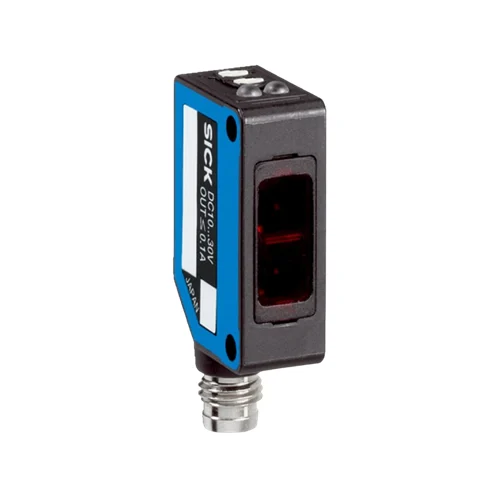
Description
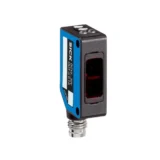
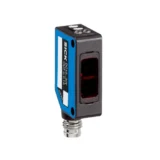
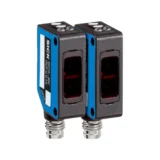
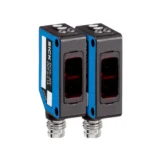
SICK WL100L-F1131S02 PNP Laser Retro Sensor
Technical Overview
The SICK WL100L-F1131S02 is a polarized retro-reflective sensor with dual-lens optics and a minimum distance to the reflector. Its 650 nm Class 1 red laser supports a 0.08–10 m sensing range with the supplied P250F reflector, with a 0.08–12 m maximum range. A 270° potentiometer adjusts sensitivity, and a separate rotary selector sets the single PNP output to light or dark operation. Response is below 0.25 ms with resistive load, with 2,000 Hz switching at a 1:1 light/dark ratio. A 200 mm PVC pigtail terminates in a four-pin M12 plug. The IP65 plastic housing is supplied with a BEF-W100-A stainless steel mounting bracket.
Class 1 polarized laser retro-reflective sensor with 0.08–10 m sensing on P250F, selectable PNP light/dark output and 200 mm M12 pigtail.
Key Features
- Polarized retro-reflective sensing with dual-lens optics and minimum reflector distance
- 0.08–10 m sensing; 0.08–12 m maximum with P250F reflector
- 650 nm visible red Class 1 laser
- 270° sensitivity potentiometer and separate light/dark rotary switch
- Single PNP output; ≤100 mA output current
- Response <0.25 ms with resistive load; 2,000 Hz at 1:1 light/dark ratio
- 200 mm PVC cable with M12 four-pin plug; 0.18 mm² conductors
- 10–30 V DC; current consumption 30 mA without load
- ABS/PC/POM housing and PMMA optics; IP65; −10 to +50 °C operation
- BEF-W100-A stainless steel 1.4301/304 bracket and P250F reflector supplied
Technical Specification Matrix
| Parameter | Value |
|---|---|
| Functional principle | Polarized photoelectric retro-reflective sensing |
| Optical arrangement | Dual-lens system with minimum reflector distance |
| Sensing range | 0.08–10 m with P250F reflector |
| Maximum sensing range | 0.08–12 m with P250F reflector |
| Other reflector ranges | PL20F: 0.08–8.5 m sensing, 0.08–10 m maximum; PL10F: 0.08–6.5 m sensing, 0.08–8 m maximum |
| Light source | Visible red laser; 650 nm |
| Laser class | Class 1 |
| Average laser service life | 50,000 h at +25 °C |
| Adjustment | Sensitivity potentiometer, 270° |
| Switching output | Single PNP |
| Switching mode | Light/dark selected by separate rotary switch |
| PNP signal HIGH/LOW | Supply voltage −1.8 V / approximately 0 V |
| Output current | ≤100 mA |
| Response time | <0.25 ms signal transit time with resistive load |
| Switching frequency | 2,000 Hz at 1:1 light/dark ratio |
| Connection | 200 mm PVC cable with M12 four-pin plug; do not bend below 0 °C |
| Conductor cross-section | 0.18 mm² |
| Pin assignment | CD-066: 1 BN=L+; 2 WH=not connected; 3 BU=M; 4 BK=Q |
| Power supply | 10–30 V DC; short-circuit-protected network, maximum 8 A |
| Ripple | ±10%; remain within supply-voltage tolerances |
| Current consumption | 30 mA without load |
| Circuit protection | Supply and input/output reverse-polarity protection; output overcurrent and short-circuit protection |
| Housing design | Rectangular |
| Housing material | ABS/PC/POM plastic |
| Optics material | PMMA plastic |
| Polarizing filter | Present |
| IP rating | IP65 |
| Mounting | M3 threaded mounting holes |
| Items supplied | BEF-W100-A stainless steel 1.4301/304 mounting bracket; P250F reflector |
| Indication | Orange LED: switching output active; green LED: power on |
| Operating temperature | −10 to +50 °C |
| Storage temperature | −40 to +70 °C |
| MTTFD | 438 years |
| DCavg | 0% |
| Manufacturer special applications | Detecting small objects; detecting objects moving at high speeds |
| Physical Weight (kg) | 0.05 |
Industrial Applications
1. Counting separated opaque articles on a conveyor
A conveyor can move separated opaque articles through the laser path between the sensor and P250F reflector. The PNP transitions feed external counting logic, using the 2,000 Hz rating and response below 0.25 ms as timing references. Commissioning establishes sufficient beam coverage and spacing at the installed reflector distance to produce distinct passage events.
Interrupted laser-beam transitions give external counting electronics article-passage events, helping track separated conveyor loads along a reflector-defined path without a separately powered receiver.
2. Triggering a station from an article leading edge
A labeling or inspection station can place the reflector path where an opaque article’s leading edge crosses the beam. That transition becomes an input to external process timing. The light/dark rotary selector adapts the PNP behavior to the station logic, while the sensitivity potentiometer and local output LED support setup of the installed optical path.
A beam-crossing event gives external process timing a location reference for the presented article, helping coordinate the next station action with its arrival.
3. Recognizing prolonged occupancy at a conveyor handoff
A conveyor handoff can place the reflector behind a normally clear receiving position so an opaque waiting load interrupts the beam. External control times the maintained PNP condition and compares it with the expected transfer interval. The sensor supplies beam-state information while the controller associates persistent occupancy with its normal machine sequence and upstream release logic.
Timing a maintained beam interruption gives external handoff control a basis for recognizing a load that remains at the receiving position and coordinating incoming material.