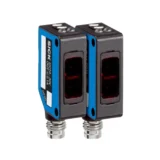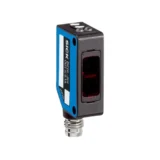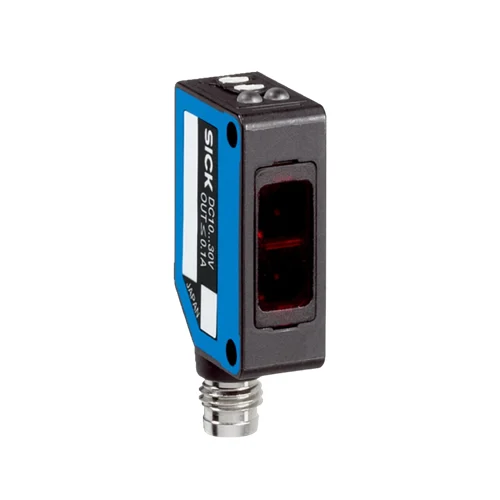
Description
SICK WT100L-F2141 PNP Energetic Laser Photoelectric Sensor
Technical Overview
The SICK WT100L-F2141 is an energetic photoelectric proximity sensor with a 650 nm visible red Class 1 laser and a single PNP digital output. Its 0–400 mm sensing range and 0–450 mm maximum range apply to a 90% remission white reference target, with a Ø2 mm light spot at 400 mm. A 270° potentiometer adjusts sensing range, and a separate L/D rotary selector sets light or dark switching. Response is less than 0.25 ms with a resistive load, and switching frequency is 2,000 Hz at a 1:1 light/dark ratio. The 10–30 V DC sensor uses an M8 three-pin connector, an IP65 ABS/PC/POM housing, PMMA optics and one supplied stainless steel mounting bracket.
Class 1 energetic laser sensor with 0–400 mm white-target range, Ø2 mm spot at 400 mm, PNP output, 2,000 Hz switching and an M8 three-pin connector.
Key Features
- Energetic photoelectric proximity sensing
- 0–400 mm sensing range; 0–450 mm maximum on 90% remission white
- 650 nm visible red Class 1 laser
- Ø2 mm light spot at 400 mm
- 270° sensing-range potentiometer and separate L/D rotary selector
- PNP digital output; ≤100 mA
- Response <0.25 ms with resistive load; 2,000 Hz at 1:1 light/dark ratio
- M8 three-pin connector
- M3 mounting holes; BEF-W100-A stainless steel bracket supplied
- IP65 ABS/PC/POM housing and PMMA optics; −10 to +50 °C operation
Technical Specification Matrix
| Parameter | Value |
|---|---|
| Functional principle | Energetic photoelectric proximity sensing |
| Sensing range | 0–400 mm on a 90% remission white reference target, DIN 5033 |
| Maximum sensing range | 0–450 mm on a 90% remission white reference target, DIN 5033 |
| Light source | 650 nm visible red laser |
| Laser class | 1 |
| Laser service life | Average 50,000 h at +25 °C |
| Light spot size | Ø2 mm at 400 mm |
| Adjustment | 270° sensing-range potentiometer |
| Switching output | PNP digital output |
| Switching mode | Light/dark switching; separate L/D rotary selector |
| Signal voltage HIGH/LOW | Supply voltage −1.8 V / approximately 0 V |
| Output current | ≤100 mA |
| Response time | <0.25 ms with resistive load |
| Switching frequency | 2,000 Hz at light/dark ratio 1:1 |
| Power supply | 10–30 V DC; limit values in a short-circuit-protected network, maximum 8 A |
| Ripple | ±10%; remain within supply-voltage tolerances |
| Current consumption | 30 mA without load |
| Circuit protection | A: supply connections reverse-polarity protected; B: inputs and output reverse-polarity protected; D: outputs protected against overcurrent and short circuits |
| Connection | M8 three-pin connector |
| Pin assignment | 1 BN=L+; 3 BU=M; 4 BK=Q (CD-045) |
| Housing design | Rectangular |
| Housing material | ABS/PC/POM plastic |
| Optics material | PMMA plastic |
| Mounting | M3 threaded mounting holes; 25.4 mm spacing |
| Items supplied | One BEF-W100-A stainless steel mounting bracket, grade 1.4301/304 |
| IP rating | IP65 |
| Operating temperature | −10 to +50 °C |
| Storage temperature | −40 to +70 °C |
| Indicators | Orange: switching output active; green: power on |
| MTTFD | 438 years |
| DCavg | 0% |
| Physical Weight (kg) | 0.01 |
Industrial Applications
1. Counting separated cartons on a conveyor
A conveyor can present separated opaque cartons to the sensor from one mounting side. Energetic optics evaluate the returned light, and the 270° potentiometer adjusts sensing range for representative cartons and their background. External counting logic evaluates the PNP transitions using the selected light/dark convention. Commissioning checks actual reflectance, gaps and transit speed against the target-specific ranges and 2,000 Hz switching specification.
Carton-passage transitions help an external counter register separated packages from one mounting side, with local sensing-range adjustment for the returned-light conditions at the conveyor.
2. Checking an insert in a stationary assembly fixture
An assembly fixture can place a small insert at a repeatable distance facing the laser spot. The 270° sensing-range potentiometer establishes a returned-light condition using representative assemblies, and external inspection logic samples the digital output while the fixture is stationary. Setup checks insert reflectance, its position relative to the light spot and background contrast, using the white-reference range only as the specified reference condition.
A returned-light reference helps external inspection logic distinguish an insert from the empty fixture condition, using local sensing-range adjustment at a repeatable inspection position.
3. Flagging prolonged occupancy at a transfer stop
A transfer stop can hold a defined carton surface in front of the sensor. External dwell logic starts a timer from the detection transition and compares continued occupancy with the expected release interval. The sensor provides the selected light/dark output state rather than an internal timing function. Setup checks actual surface reflectance, settled distance and the background return before the timer is commissioned.
An occupied-position reference allows external dwell logic to flag a carton remaining beyond its release interval, helping locate a stalled transfer at the monitored stop.