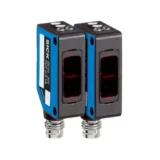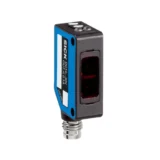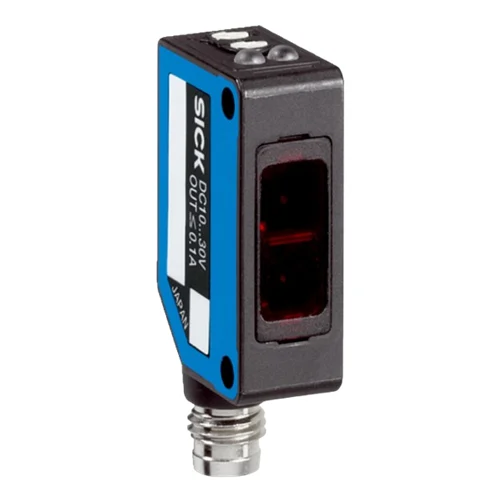
Description
SICK WT100L-E1141 NPN Laser Diffuse Sensor
Technical Overview
The SICK WT100L-E1141 is an energetic photoelectric proximity sensor using a visible 650 nm Class 1 laser. It senses light reflected from the target, with a 0–400 mm sensing range and 0–450 mm maximum range on 90% remission reference white. The 2 mm light spot at 400 mm supports small-object positioning. A 270° potentiometer adjusts sensing range, and a separate rotary switch selects light or dark output behavior. Its NPN output has a response below 0.25 ms with resistive load and a 2,000 Hz switching rating at a 1:1 light/dark ratio. The IP65 plastic housing connects through a 2 m three-wire PVC cable and is supplied with a stainless steel mounting bracket.
Energetic Class 1 laser proximity sensor with 0–400 mm reference-white sensing, NPN output, 2,000 Hz switching and a 2 m PVC cable.
Key Features
- Energetic reflected-light proximity sensing from one mounting side
- 0–400 mm sensing; 0–450 mm maximum on 90% remission reference white
- 650 nm visible red Class 1 laser; Ø2 mm spot at 400 mm
- 270° sensing-range potentiometer and separate light/dark rotary selector
- Single NPN output; maximum output current ≤100 mA
- Response <0.25 ms with resistive load; 2,000 Hz at 1:1 light/dark ratio
- 10–30 V DC; 30 mA consumption without load
- 2 m three-wire PVC cable; 0.18 mm² conductors
- ABS/PC/POM housing and PMMA optics; IP65; −10 to +50 °C operation
- BEF-W100-A stainless steel 1.4301/304 mounting bracket supplied
Technical Specification Matrix
| Parameter | Value |
|---|---|
| Functional principle | Energetic photoelectric proximity sensor |
| Sensing range | 0–400 mm on 90% remission reference white, DIN 5033 |
| Maximum sensing range | 0–450 mm on 90% remission reference white, DIN 5033 |
| Light source | Visible red laser; 650 nm |
| Laser class | Class 1 |
| Average laser service life | 50,000 h at +25 °C |
| Light spot size | Ø2 mm at 400 mm |
| Manufacturer special applications | Detecting small objects; detecting objects moving at high speeds |
| Adjustment | Sensing-range potentiometer, 270° |
| Switching output | Single NPN output |
| Switching mode | Light/dark switching selected by separate L/D rotary switch |
| NPN signal voltage | HIGH approximately supply voltage; LOW <1.8 V |
| Output current | ≤100 mA |
| Response time | <0.25 ms signal transit time with resistive load |
| Switching frequency | 2,000 Hz at 1:1 light/dark ratio |
| Connection | 2 m three-wire PVC cable; do not bend below 0 °C |
| Conductor cross-section | 0.18 mm² |
| Conductor functions | CD-043: BN=L+; BU=M; BK=Q |
| Power supply | 10–30 V DC; short-circuit-protected network, maximum 8 A |
| Ripple | ±10%; remain within supply-voltage tolerances |
| Current consumption | 30 mA without load |
| Circuit protection | Supply and input/output reverse-polarity protection; output overcurrent and short-circuit protection |
| Housing material | ABS/PC/POM plastic |
| Optics material | PMMA plastic |
| IP rating | IP65 |
| Mounting | M3 threaded mounting holes |
| Items supplied | BEF-W100-A stainless steel mounting bracket, 1.4301/304 |
| Indication | Orange LED: switching output active; green LED: power on |
| Operating temperature | −10 to +50 °C |
| Storage temperature | −40 to +70 °C |
| MTTFD | 453 years |
| DCavg | 0% |
| Physical Weight (kg) | 0.05 |
Industrial Applications
1. Counting small separated components on a transport track
A transport track can move opaque components through the red-laser sensing point and feed NPN transitions to external counting electronics. The 2 mm spot at 400 mm helps define the optical location, while the 2,000 Hz rating and response below 0.25 ms provide the timing basis. Commissioning verifies actual target reflectance, coverage and separation rather than assuming the reference-white range for every material.
A defined laser sensing point produces passage events for the external counter, helping track small separated components without requiring a receiver across the transport track.
2. Triggering a process step from a passing leading edge
A labeling or inspection station can aim the sensor at the expected face of a moving opaque article. The transition when its leading edge reaches the sensing point becomes an input to external process timing. The rotary selector chooses light or dark logic, and the sensing-range potentiometer adapts the reflected-light condition to the installed article surface and distance.
A localized optical edge event gives external timing logic a repeatable process reference for the presented article, helping coordinate the next station action with its arrival.
3. Monitoring material at a fixed chute-level threshold
A parts chute can present opaque material at a fixed optical threshold and use the NPN state to indicate whether that location remains occupied. Reflected-light sensing works from one side, with local range adjustment adapting the response to the actual material and background. External logic can time a persistent absence condition before issuing a replenishment request for the feeding process.
A persistent change at the selected optical threshold gives external feeder logic a material-presence reference, helping request replenishment before the monitored chute location remains empty.