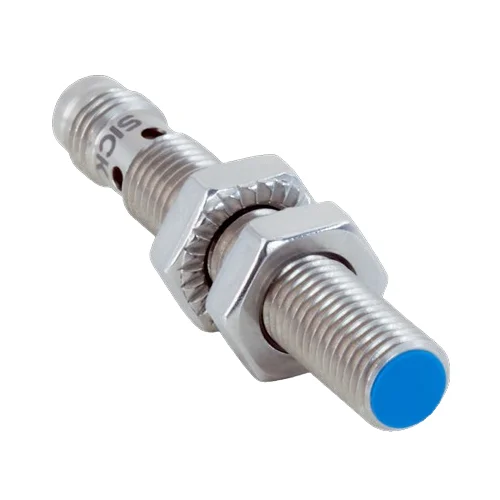
Description
SICK IMB08-02BDSVTOS Two-wire Inductive Sensor
Technical Overview
The SICK IMB08-02BDSVTOS is a flush M8 × 1 inductive proximity sensor with 2 mm nominal and 1.62 mm assured sensing range. Its normally-open DC two-wire circuit supports 4,000 Hz switching, with minimum load current 3 mA and typical off-state current 0.8 mA. The M8 three-pin connector has gold-plated contacts, with pins 1 and 3 used for the two-wire connection and pin 4 unconnected. A V2A stainless steel housing, LCP sensing face and visual adjustment indicator support use in coolant/lubricant zones. The 50 mm housing has a 38 mm thread, two toothed V2A nuts and IP68/IP69K protection, with −40 to +100 °C operation.
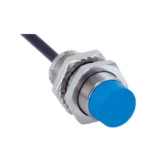
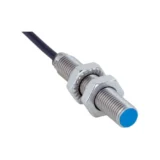
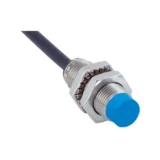
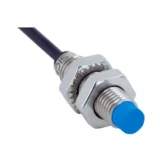
Flush M8 inductive sensor with 2 mm nominal range, two-wire normally-open operation, 4,000 Hz switching and gold-contact M8 three-pin connector.
Key Features
- M8 × 1 flush inductive sensor; 2 mm nominal and 1.62 mm assured range
- DC two-wire normally-open circuit; 4,000 Hz switching
- Minimum load current ≥3 mA; typical off-state current 0.8 mA
- Voltage drop ≤4 V at 30 mA and ≤4.5 V at maximum output current
- Gold-plated M8 three-pin contacts; pin 4 not connected
- V2A stainless steel DIN 1.4305/AISI 303 housing; LCP sensing face
- Coolant/lubricant resistance and visual adjustment indicator
- IP68 to EN 60529; IP69K to ISO 20653:2013-03
- 50 mm housing, 38 mm thread and two toothed V2A mounting nuts, 13 mm across flats
- 10–30 V DC; −40 to +100 °C operation; short-circuit protection
Technical Specification Matrix
| Parameter | Value |
|---|---|
| Functional principle | Inductive proximity sensing |
| Mounting thread | M8 × 1; Ø8 mm |
| Installation | Flush |
| Nominal sensing range Sn | 2 mm |
| Assured sensing range Sa | 1.62 mm |
| Output function | Normally open (NO) |
| Electrical wiring | DC two-wire |
| Switching frequency | 4,000 Hz |
| Connection | M8 three-pin connector with gold-plated contacts |
| Pin assignment | CD-246: 1 BN=L+; 4 BK=not connected; 3 BU=M |
| Special features | Coolant/lubricant resistance; visual adjustment indicator; temperature resistance |
| Manufacturer application areas | Coolant and lubricant zones; mobile machines; difficult application conditions |
| Power supply | 10–30 V DC |
| Ripple | ≤10% |
| Voltage drop | ≤4 V at 30 mA; ≤4.5 V at maximum output current |
| Time delay before availability | ≤100 ms |
| Hysteresis | 3–20% |
| Reproducibility | ≤2% of Sr at constant supply voltage and ambient temperature |
| Temperature drift of Sr | ±10% |
| Continuous output current | ≤100 mA |
| Off-state current | Typical 0.8 mA; ≤1.2 mA at maximum supply voltage and +100 °C |
| Minimum load current | ≥3 mA |
| Short-circuit protection | Provided |
| Power-up pulse | ≤5 ms |
| Housing material | V2A stainless steel, DIN 1.4305 / AISI 303 |
| Sensing face material | LCP plastic |
| Housing length | 50 mm |
| Thread length | 38 mm |
| Items supplied | Two V2A stainless steel mounting nuts with locking teeth; 13 mm across flats |
| Tightening torque | Typical 7 Nm using non-toothed nut side; typical 14 Nm using toothed side |
| Flush installation clearances | Manufacturer diagram keys: B=6.5 mm; C=8 mm; D=6 mm; F=16 mm |
| Material reduction factors | Reference values that may vary: St37 steel 1; V2A/304 approximately 0.74; aluminum approximately 0.43; copper approximately 0.33; brass approximately 0.46 |
| IP rating | IP68 to EN 60529; IP69K to ISO 20653:2013-03 |
| Protection class | III |
| Operating temperature | −40 to +100 °C |
| Shock resistance | 100 g / 11 ms / 1,000 cycles; 150 g / 1,000,000 cycles, as specified |
| Vibration resistance | 10–55 Hz, 1 mm; 55–500 Hz, 15 g |
| EMC | EN 60947-5-2 |
| UL file | E181493 |
| MTTFD | 1,287 years |
| DCavg | 0% |
Industrial Applications
1. Confirming a clamp beside a machining fixture
A machining fixture can present a metal clamp target to the flush sensing face at a controlled seated gap. Coolant/lubricant resistance and V2A/LCP construction support a sensing location near the process. External sequence logic reads the normally-open two-wire state through a compatible input, with installation accounting for assured range, target-material reduction, voltage drop and off-state current.
An inductive clamp-position reference helps external sequence logic distinguish a seated metal target from an open fixture location while using a sensor specified for coolant and lubricant environments.
2. Counting metal tabs on a rotating mechanism
A rotating mechanism can pass separated metal tabs across the flush sensing face and feed the normally-open two-wire transitions into compatible external counting electronics. The 4,000 Hz rating supports assessment of tab passage frequency and spacing. Input design accounts for minimum load current, voltage drop and off-state current, while commissioning checks actual target material and installed operating gap.
Repeated metal-target transitions provide external counting electronics with passage events, helping track cycles or indexing movements without a contacting switch against the rotating tabs.
3. Monitoring loss of an expected motion pulse train
A machine can present regularly spaced metal flags during commanded motion and let external logic monitor the interval between normally-open two-wire transitions. A prolonged absence of expected events indicates a stopped or interrupted target passage. Commissioning checks the actual material, gap and flag spacing, with compatible input loading that accounts for the specified off-state current and minimum load requirement.
A recurring inductive signal gives external motion monitoring an event reference, helping recognize unexpected loss of movement when target transitions cease during a commanded running interval.